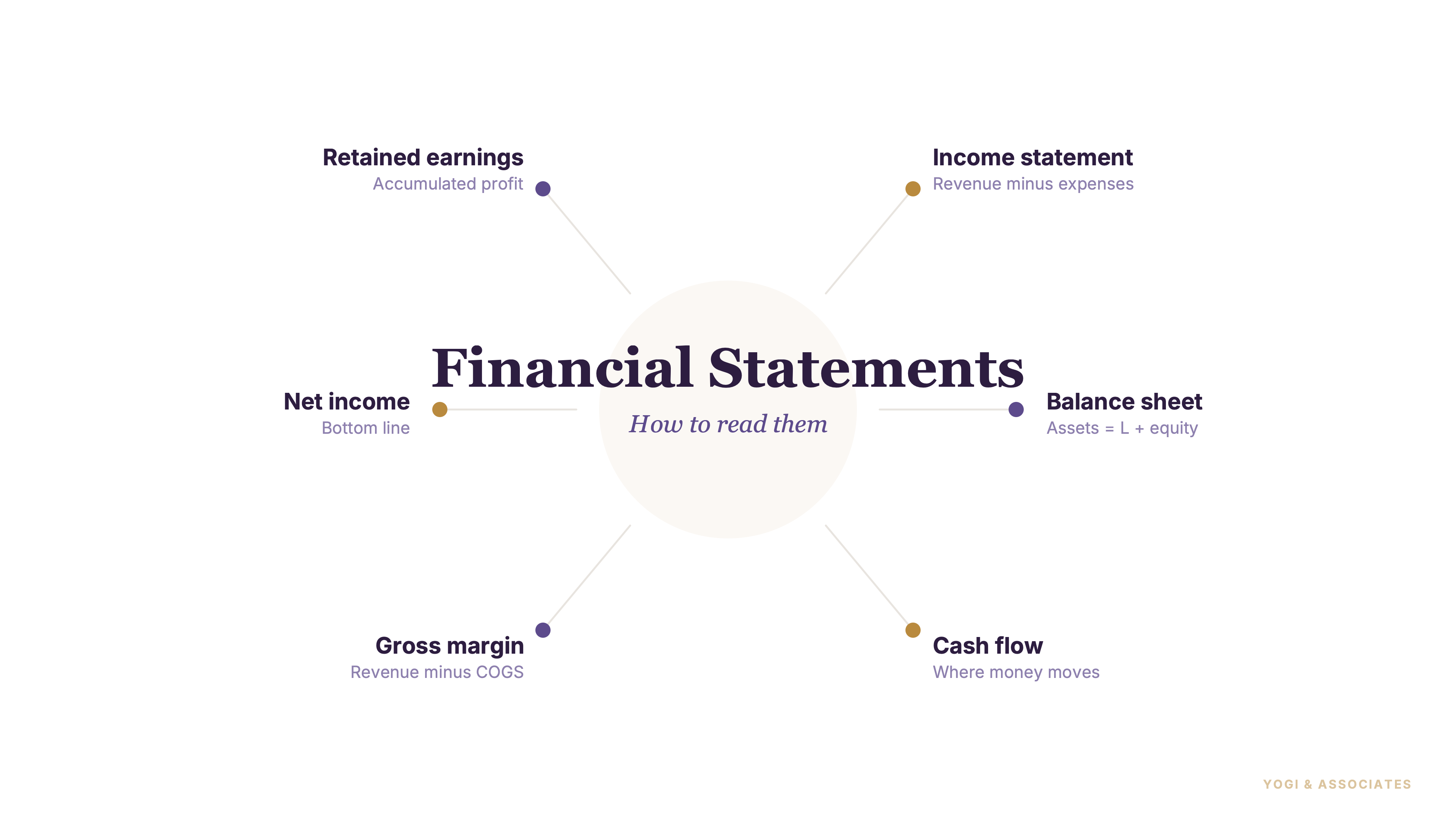
1. Start with what each statement does
Most confusion starts because owners expect one statement to answer every question. It does not.
The income statement explains performance over time. But the balance sheet explains position on one date, and the cash flow statement explains movement in actual cash.
Reading them in that order works best. Our bookkeeping guide is the broader map, but this post is the plain-English decoder ring.
2. Read the income statement first
Start at the top and move downward. Revenue minus cost of goods sold gives you gross profit, and gross profit minus operating expenses gets you to operating income.
Then interest, taxes, and other items pull you down to net income. So the P&L is really a story about what was sold, what it cost to deliver, and what was left after running the place.
owners should spend more time on gross profit than on the final line. That is where pricing problems, labour creep, and delivery issues usually show up first.
3. Read the balance sheet like a snapshot
The balance sheet is less emotional and more revealing. Assets always equal liabilities plus equity, and if that relationship is off, the books are off.
Current items usually turn into cash or come due within a year. But non-current items sit longer, which is why the current side tells you more about immediate pressure.
Owners should stop skipping this statement. it is where weak receivables, debt pressure, and a thin cash position become obvious long before the bank balance alone tells the full story.
4. Use cash flow to explain the bank account
The cash flow statement is the peacemaker between profit and panic. It breaks cash movement into operating, investing, and financing activities.
Operating cash is what the business generated from actually running. And investing cash usually relates to buying or selling assets, while financing cash shows loans, owner money, and distributions.
We've found this statement is the most ignored one until cash gets tight. But it is often the best explanation for why a profitable month still felt uncomfortable.
5. Watch a few ratios, not fifty
Owners do not need a giant KPI deck first. They need a short list that actually means something.
Gross margin is gross profit divided by revenue, and net margin is net income divided by revenue. So both ratios tell you how much of each sales dollar survives at different stages of the statement.
The thing is, trends matter more than a random isolated number. The current ratio matters too, because current assets divided by current liabilities gives you a fast read on short-term breathing room.
6. Why net income and cash keep disagreeing
This is the question we hear most. A business can show profit and still feel cash-poor.
That happens because accrual books record revenue when earned and expenses when incurred, not when cash moves. So unpaid invoices, unpaid bills, inventory changes, and loan principal can all make the bank account behave differently from net income.
Every owner should understand this before blaming the bookkeeper or the software. Our cash versus accrual guide and our monthly bookkeeping checklist are the next reads if this mismatch keeps showing up in your file.
7. Where CRA and GIFI fit into all this
The statements are not just internal management tools. They also feed tax compliance.
CRA says corporations filing a T2 return have to include financial statement information using GIFI (General Index of Financial Information — the CRA-prescribed line numbers used to translate your books into the format CRA wants on a T2 return). But GIFI is not a different set of books; it is a translation layer that turns your income statement and balance sheet into the CRA format.
Owners should care about that because bad bookkeeping becomes bad tax filing very quickly. Our T2 corporate tax guide is the next stop if you want to see how those statement numbers flow into the corporate return.
Financial statements should help you make decisions, not make you feel lost. If you want clean reports and someone to explain what they actually mean, we can help.
Book a Free Consultation