1. Your remitter type controls everything
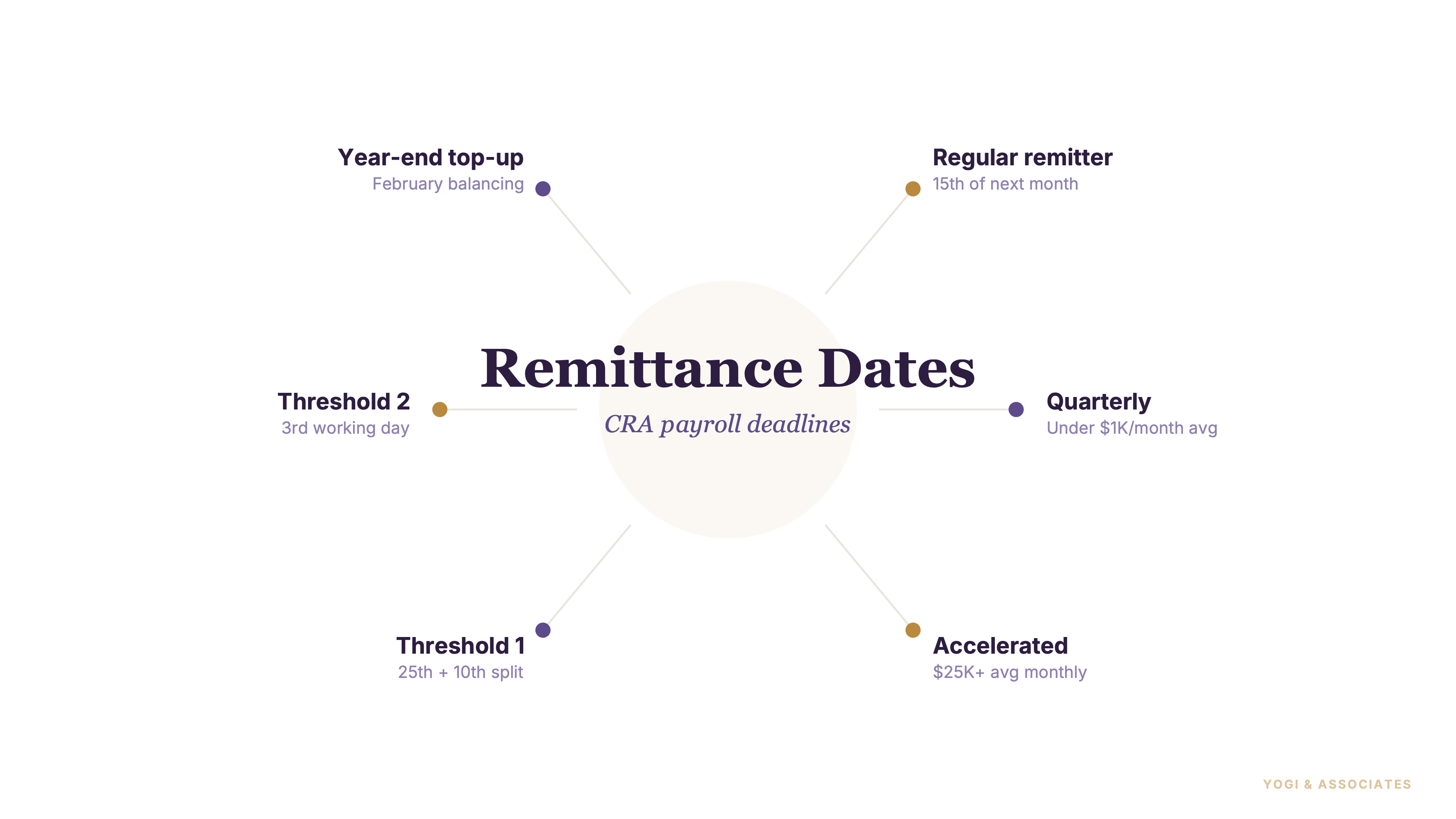
If you run payroll in Ontario, the first thing to know is that CRA does not give every employer the same payroll calendar. It sorts employers into quarterly, regular, accelerated threshold 1, or accelerated threshold 2 remitters.
That classification decides how often source deductions have to be sent in. This is the first payroll setting employers should check, because almost every late remittance story starts with the wrong assumption about frequency.
So if you need the bigger payroll picture first, start with our Canadian payroll guide. And if you want the deduction side behind those remittances, our CPP guide and EI guide are the natural next reads.
2. Quarterly and regular remitters are the easy ones
Existing employers can qualify as quarterly remitters if the AMWA in the calendar year before the previous calendar year was less than $3,000 and they kept a perfect compliance record over the previous 12 months.
Quarterly deadlines are April 15, July 15, October 15, and January 15. Regular remitters are employers with an AMWA of less than $25,000, and they remit by the 15th day of the month after the month they paid employees.
These are the easiest schedules to manage, but only if you actually know which one applies. So do not assume monthly just because that is what you did last year.
3. Threshold 1 means twice-monthly deadlines
Threshold 1 accelerated remitters have an AMWA of $25,000 to $99,999.99. That range pulls you out of the regular monthly cycle.
CRA says threshold 1 remitters pay twice a month. Amounts from the first 15 days are due by the 25th of the same month, and amounts from the second half are due by the 10th of the following month.
In our view, this is where growing businesses first get surprised. But the dates are not confusing once you write them down in the calendar the right way.
4. Threshold 2 is the serious one
Threshold 2 accelerated remitters have an AMWA of $100,000 or more. At that point CRA wants money much faster.
The rule is within 3 working days following the end of each remitting period. CRA breaks those periods into the 1st through 7th, the 8th through 14th, the 15th through 21st, and the 22nd through the last day of the month.
This is the schedule most likely to cause accidental penalties after a growth spurt. So if you are nearing $100,000, check the payroll file before CRA checks it for you.
5. CRA assigns your type from AMWA and shows it on PD7A
CRA says your remitter type for the current year is generally based on your AMWA from two calendar years ago. That lookback catches people off guard because it is not based only on what happened last month.
The easiest place to check is your PD7A (the CRA statement that shows your remittance history and your assigned remitter type). Every employer should know where that document is, or check the same remitting requirements in My Business Account.
But do not wait for a panic moment to read it. In our view, the PD7A is one of the most ignored useful payroll documents CRA sends.
6. Late remittance penalties add up fast
CRA's late remittance schedule is simple and annoying. The penalty is 3% if you are 1 to 3 days late, 5% if you are 4 or 5 days late, 7% if you are 6 or 7 days late, and 10% if you are more than 7 days late or did not remit at all.
Those numbers get expensive faster than employers expect. The jump from 3% to 10% is the part people underestimate most, especially when several remittance periods are affected.
So a missed date is not just an admin issue. It turns into a direct cash cost almost immediately.
7. Remitting is easy once the schedule is right
CRA gives employers a few ways to pay. You can pay through My Business Account, through online business banking, or by using the paper PD7A where it still applies.
The hard part is usually not the payment method. The real risk is using the wrong due date for the remitter type you actually have.
So build the payment method once, then keep watching the classification. And if payroll deadlines are getting harder instead of easier, our tax deadlines guide helps with the calendar side too.
Payroll remittance problems are usually caused by timing, not math. If you want the deductions, remittances, and deadlines handled properly, we can help.
Book a Free Consultation