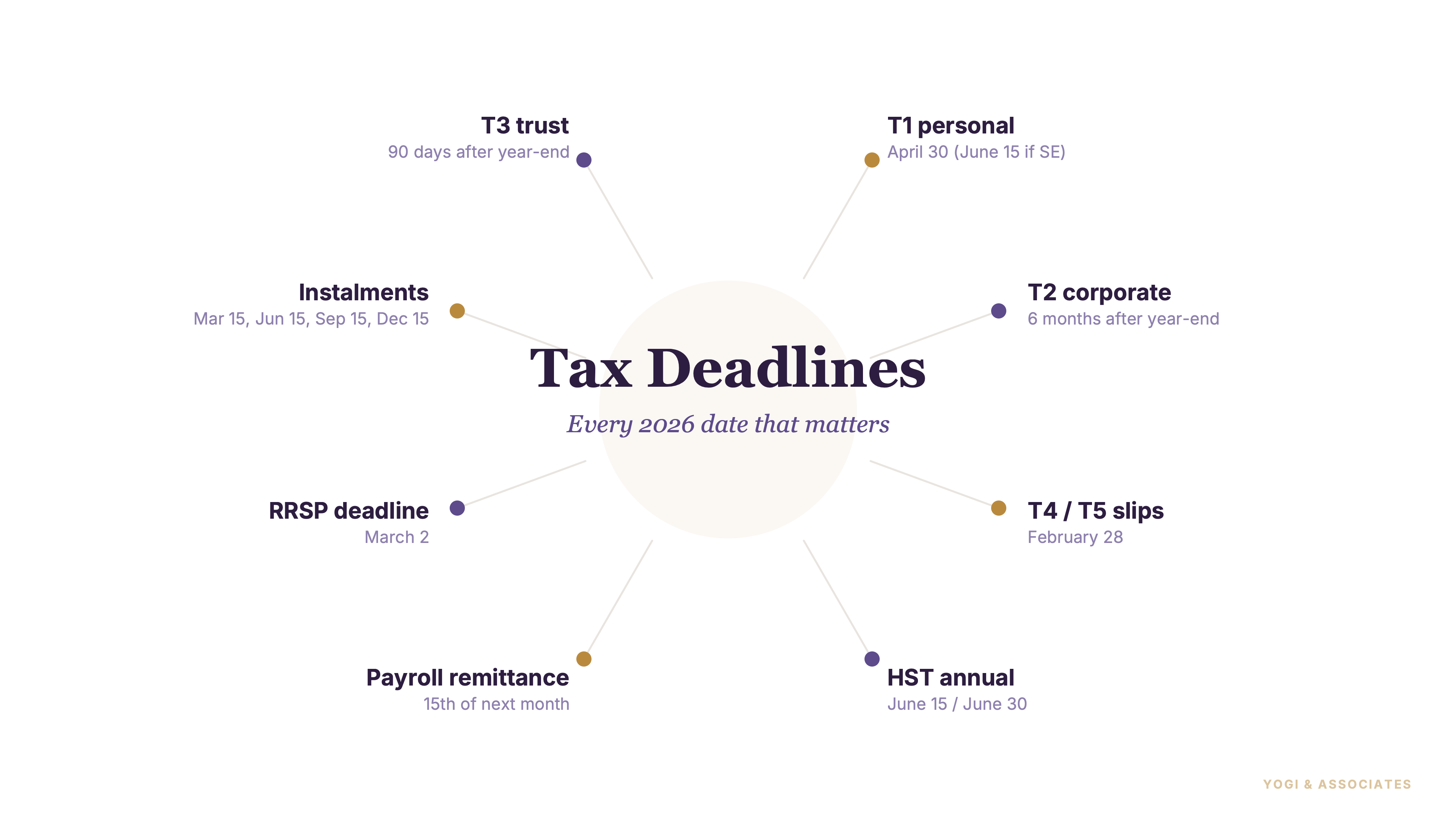
1. The dates that matter most
Whether you file a personal return, run payroll, or own a corporation in Ontario, these are the 2026 dates that matter. If you only remember three, make them these: March 2, April 30, and June 15.
March 2 covers your RRSP contribution and your T4/T5 slip filing. April 30 covers T1 personal returns and — more importantly — every balance owing, even for self-employed filers. June 15 is when the self-employed filing extension actually ends.
most penalty bills we see come from people who thought June 15 meant “pay later too.” It doesn't — you can file later, but you can't pay later without interest.
2. T1 personal returns
For most individuals, your 2025 T1 return is due April 30, 2026. That's a Thursday, no weekend shift.
Any balance owing is also due April 30. And interest on unpaid balances starts the very next day — May 1.
If you or your spouse had self-employment income in 2025, you get until June 15, 2026 to file the return itself. But the CRA rules are brutal on this point: balance owing is still due April 30. The extra six weeks is filing time only.
This is the single most misunderstood rule in the Canadian tax system. So if you're self-employed and you owe, estimate early and send the payment on April 30 — you can clean up the exact numbers on the return later.
For the fuller walkthrough, see our tax preparation guide.
3. RRSP and slip deadlines
The RRSP deadline for the 2025 tax year is March 2, 2026. Normally it's March 1, but March 1 lands on a Sunday in 2026 — so the deadline rolls to Monday.
Anything you contribute between March 4, 2025 and March 2, 2026 is eligible for your 2025 deduction. If you contribute between March 3, 2026 and the end of the year, it's a 2026 deduction.
T4 and T5 slips follow the same calendar trick. The rule is “last day of February” — which this year means March 2, 2026, because February 28 is a Saturday. If you're an employer or you pay dividends from a private corporation, this date is non-negotiable.
And here's the opinion: we see way too many owners leave T5 dividend slips to the last second. Plus late slips trigger a per-slip penalty plus interest on the shareholder's own T1. So build the slips in January, not late February.
4. T2 corporate returns
T2 corporate tax returns are due six months after fiscal year-end. So a Dec 31, 2025 year-end files by June 30, 2026. A March 31, 2026 year-end files by September 30, 2026.
The payment side is different. Most Canadian-controlled private corporations have to pay the balance within two months of year-end, not six. Some CCPCs qualify for a three-month extension.
So the return and the payment are on separate clocks. Which catches owners off guard — they think “June 30” and forget there was a February 28 payment. We walk through all of this in our T2 corporate tax return guide.
5. GST/HST filing deadlines
HST deadlines depend on how often you file. The CRA assigns reporting periods based on your annual taxable sales.
- Monthly filers — return and payment due one month after the end of the reporting period.
- Quarterly filers — return and payment due one month after the end of the quarter. So a Q1 2026 period ending March 31 is due April 30.
- Annual filers (corporations) — three months after fiscal year-end.
- Annual filers (self-employed individuals with Dec 31 year-end) — file by June 15, 2026, but pay any balance by April 30, 2026.
That last line trips up almost every self-employed HST registrant we onboard. The filing date and the payment date are different. Same trap as the T1.
And honestly, HST arrears are the fastest way to land in serious CRA trouble. We've covered why in our post on CRA interest and penalties for businesses — that money was never yours, you were holding it for the government.
6. Payroll remittance dates
Payroll remittance deadlines depend on your remitter type. CRA sorts employers into four buckets based on a two-year-old number called the AMWA — average monthly withholding amount, which is basically how much tax, CPP, and EI you sent to CRA two calendar years ago divided by the remittance months.
- Regular remitter (AMWA under $25,000) — due the 15th of the month after you paid the employees.
- Threshold 1 accelerated (AMWA $25,000 to $99,999.99) — pay by the 25th of the same month for pay dates in the first half, and by the 10th of the next month for pay dates in the second half.
- Threshold 2 accelerated (AMWA $100,000 or more) — pay within three business days of the pay period end, and only through a Canadian financial institution.
- Quarterly (small new employers who qualify) — due the 15th of the month after each quarter.
the bucket change is where most owners get burned. You hire a few people, payroll grows, and two years later CRA reclassifies you from regular to Threshold 1 — but nobody tells bookkeeping. Then the 15th suddenly stops being your deadline and you're ten days late every remittance.
Want to understand the per-employee math behind all this? We broke down the CPP, EI, and income tax side in our guide on payroll for small business.
7. CRA instalments
If you owe CRA more than $3,000 in net tax (over $1,800 for Quebec residents) in the current year and in one of the two prior years, you're in instalment territory.
For individuals, the 2026 instalment due dates are March 15, June 15, September 15, and December 15. Miss one and CRA charges instalment interest — a separate charge from arrears interest on your main balance.
For corporations, instalments are usually monthly (or quarterly for some small CCPCs) and due the last day of each month after your fiscal year-end starts. So a Dec 31 year-end means instalments on the last day of January, February, March, and so on.
The dumbest penalty in the tax code is getting dinged for instalment interest when you already paid your full balance by April 30. It happens constantly. CRA wants the money earlier in the year, not all at once.
8. T3 trust returns
T3 trust returns are due 90 days after the trust's year-end. For a calendar-year trust (December 31, 2025 year-end), that's March 31, 2026.
Any balance owing is due the same day. And with the new trust reporting rules that came in a couple years ago, bare trusts and family trusts with more than a handful of beneficiaries now need Schedule 15 attached.
So if you have a family trust, please don't wait until April to start gathering the beneficiary info. We see clients every year scrambling because the 90-day window is shorter than they think.
9. How to not miss these
Here's the order we use with clients to keep the year clean:
- Put the five big dates in one calendar. March 2, March 31, April 30, June 15, June 30 (for Dec 31 T2 filers). Repeat them every year.
- Separate filing dates from payment dates. These are almost always different for self-employed and HST. Treat the earlier one as your real deadline.
- Know your remitter type. Pull a PD7A from CRA My Business Account once a year and confirm your payroll threshold hasn't shifted.
- Estimate balances in March. Not on April 25. The goal is to pay a round number by April 30 and fix the math on the return later.
- Track instalment notices separately. They come quarterly and the penalty math is its own beast.
So that's the whole year on one page. Want the longer walkthrough on how to actually file? Read our tax preparation guide or look at specific services like personal tax and corporate tax.
And if instalments or HST deadlines are where you keep tripping, our salary vs dividends post and the CRA interest and penalties post cover the math behind the dates.
Missing deadlines is how small bills become big ones. If the 2026 calendar is giving you a headache, let's sort out your year before the next date passes.
Book a Free Consultation