1. The worst payroll mistake is usually timing
Most Ontario employers think the scariest payroll mistake is a complicated calculation error. The more common expensive mistake is simply not sending the money on time.
Payroll is different because the cash you withhold is not really your cash. So if you miss a remittance date, the problem is not just lateness. It is lateness on money CRA treats very seriously.
That is why our CRA remittance deadline guide matters so much. And if you need the full payroll framework around it, start with our Canadian payroll guide first.
2. Late remittance penalties escalate fast
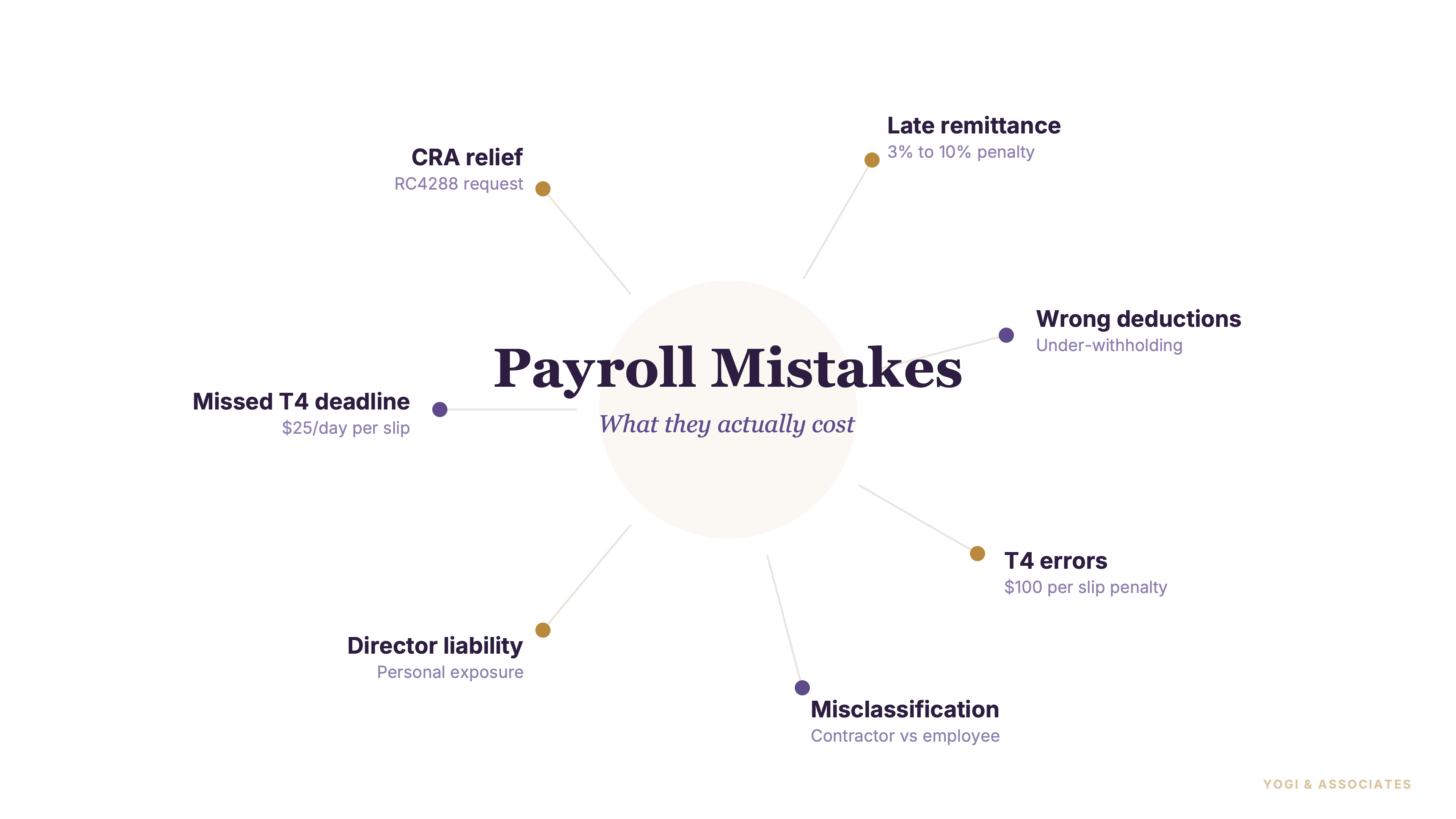
CRA's late remittance scale is blunt. The penalty is 3% if you are 1 to 3 days late, 5% if you are 4 or 5 days late, 7% if you are 6 or 7 days late, and 10% if you are more than 7 days late or did not remit at all.
And there is a second punch. CRA says a 20% penalty can apply if it assessed a 10% penalty before in the same calendar year and the new failure was made knowingly or under circumstances amounting to gross negligence.
Employers underestimate how fast this stacks up when several payroll periods are affected. So one late cycle can become a pattern before anyone notices the cash drain.
3. Failing to deduct is a separate problem
Some employers focus so much on remitting that they miss the earlier problem. If you never deducted what you were supposed to deduct, CRA has a separate penalty for that.
CRA says the penalty is 10% of the amount you failed to deduct for CPP, EI, or income tax. And if you fail to deduct again in the same calendar year and it was done knowingly or under circumstances amounting to gross negligence, the penalty becomes 20%.
In our view, this is where worker setup mistakes start turning ugly. But if you classify people properly and run payroll cleanly, most of this stays avoidable.
4. T4 filing mistakes have their own cost
T4 season has a separate penalty system. CRA's late-filing schedule starts at $10 per day for 1 to 50 slips, with a minimum penalty of $100 and a maximum of $1,000.
After that, the daily amount rises with the slip count: $15 per day for 51 to 500 slips up to $2,500, $30 per day for 501 to 2,500 slips up to $5,000, $50 per day for 2,501 to 10,000 slips up to $15,000, and $75 per day for 10,001 or more slips up to $75,000.
Year-end penalties feel smaller than remittance penalties only until the first notice arrives. So if your issue is slip accuracy or filing timing, our T4 guide is the first place to tighten the process.
5. Payroll deductions are trust money, not working capital
CRA and the Income Tax Act treat source deductions as money held in trust. Under subsection 227(4), once you withhold the deductions, they are deemed to be held separate and apart in trust for the Receiver General.
That legal idea is the reason CRA reacts so aggressively to payroll arrears. This is the concept employers need to understand cold, because it explains why payroll debt is not treated like an ordinary vendor balance.
Plus the same mindset shows up on the indirect tax side too. So if you want the parallel HST version of this problem, read our GST/HST penalties guide as well.
6. Directors can get dragged in personally
This is the part owners hate hearing. Director liability (the rule that lets CRA pursue corporate directors personally for unremitted source deductions and HST after the company can't pay) is real.
Under section 227.1 of the Income Tax Act, CRA can assess directors personally for unremitted payroll deductions after it has tried and failed to collect from the corporation. Under section 323 of the Excise Tax Act, the same basic rule applies to unremitted GST/HST.
And there is a timing rule too. CRA generally has only two years after a person stops being a director to assess that director. This is why payroll problems should never be treated as something the corporation will "sort out later."
7. Fix errors fast and ask for relief when it fits
If you catch a T4 error, fix it quickly. CRA says to prepare an amended slip using the same type of slip, write "AMENDED" at the top, and send the corrected copies where they need to go.
And if the problem has already triggered penalties or interest, there is still one more path. Under subsection 220(3.1), CRA can consider taxpayer relief (CRA's mechanism to waive or cancel penalties in extraordinary circumstances — natural disasters, hospitalization, CRA error), and Form RC4288 is the request form.
Penalty relief is worth asking for when the facts actually support it, especially in cases of extraordinary circumstances, financial hardship, or CRA error. So if the file is already messy, get help early through our CRA audit support service instead of improvising under pressure.
Payroll problems get cheaper the earlier you catch them. If you want help fixing errors or tightening controls before CRA gets there first, we can help.
Book a Free Consultation