1. Start with the deadline, not the boxes
If you paid employees in Ontario this year, T4 slips are your responsibility. The filing order matters. Owners should start with the due date first, because that date drives every cleanup decision behind it.
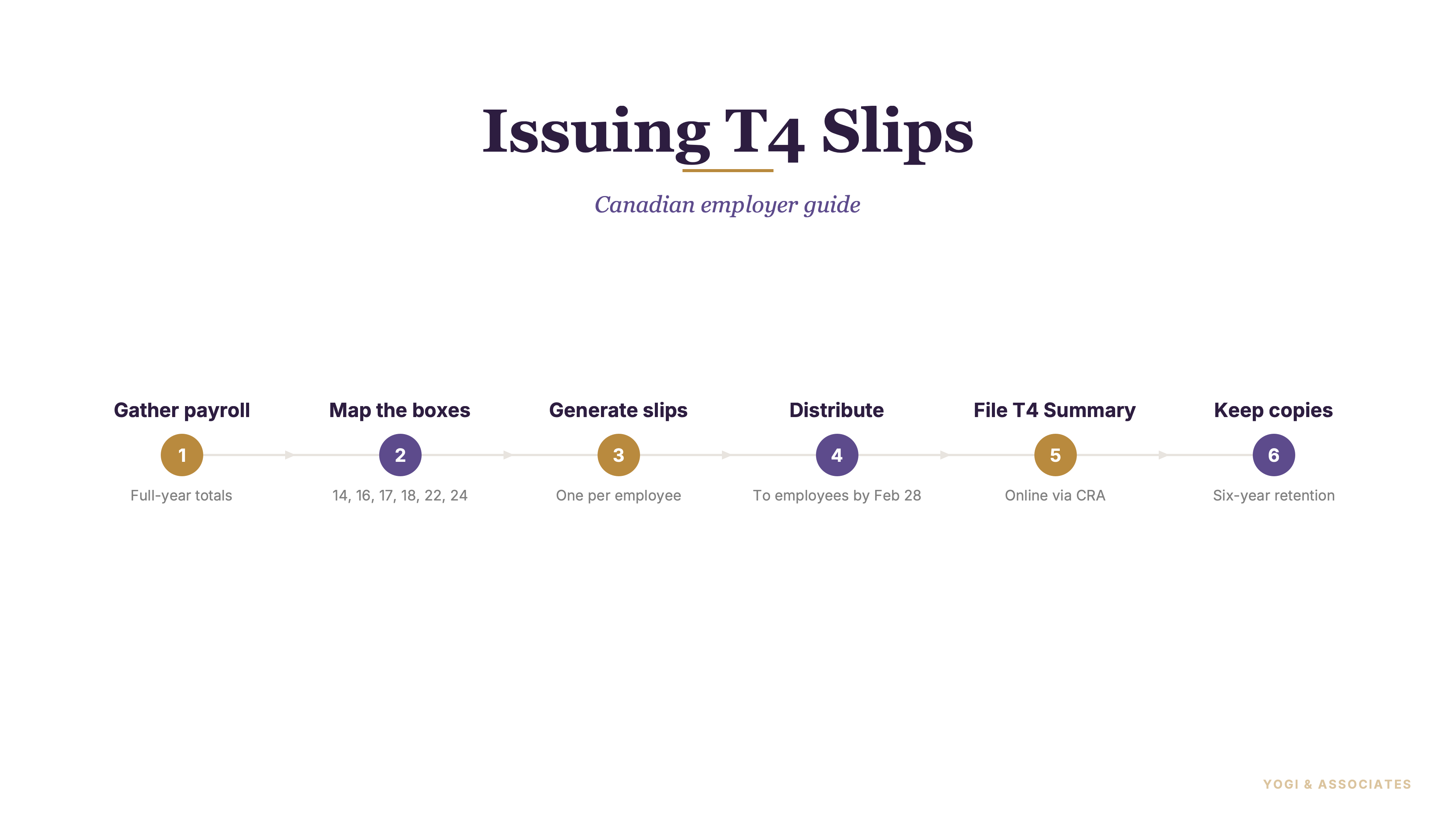
CRA says you have to give T4 slips to employees and file the T4 Summary with CRA on or before February 28 after the calendar year ends. If February 28 lands on a weekend, the deadline moves to the next business day.
So do not wait until late February to see whether payroll records actually tie out. Our Canadian payroll guide and our 2026 tax deadlines post are the two pages every first-time payroll employer should keep open during year-end.
2. Know what the T4 slip and T4 Summary do
A T4 slip gives one employee's year-end payroll picture. A T4 Summary (the cover page that totals all your T4 slips for CRA — required even if you only have one employee) gives CRA the rolled-up totals for the whole payroll account.
And both rely on source deductions (the income tax, CPP, and EI you withhold from each paycheque and remit to CRA on the employer's behalf) being correct all year, not just in February. That is why T4 prep is really a payroll review, not a form-filling exercise.
But if the payroll file was messy all year, the slips will only reflect that mess more neatly. In our view, that is why year-end payroll should never begin with the PDF form itself.
3. Fill the income and deduction boxes properly
Start with the core boxes almost every employee will have. Box 14 is employment income before deductions, including salary, wages, commissions, bonuses, tips, gratuities, and honoraria.
Box 16 is the employee's base CPP contributions. Box 16A is the employee's CPP2 contributions.
Box 18 is the employee's EI premiums. Box 22 is income tax deducted.
Box mapping errors are one of the most avoidable payroll mistakes. So if you need a refresher on the deduction side first, read our CPP and CPP2 guide and our 2026 EI premiums guide before you touch the slips.
4. Do not ignore the earnings boxes
Many employers get the deduction boxes right and still blow the earnings boxes. That is a problem because CRA uses them to test whether the deductions make sense.
Box 24 is EI insurable earnings. It reports the insurable earnings used to calculate the EI amount in box 18.
Box 26 is CPP pensionable earnings. It reports the pensionable earnings used to calculate the CPP and CPP2 amounts in box 16 and box 16A, up to the additional maximum pensionable earnings for the year.
These two boxes deserve a separate review every time. But too many employers just trust the software and never compare the earnings logic to the payroll history.
5. A few other boxes matter more than owners expect
Not every T4 is only wages, CPP, EI, and tax. Some files also need box 44 and box 52.
Box 44 reports union dues deducted from the employee when those dues are reported on the slip. Box 52 reports the employee's pension adjustment.
In our view, these are easy boxes to overlook because they do not show up on every payroll file. So if your business has a union setting or a pension arrangement, review those amounts separately instead of assuming they will fill themselves.
6. Know when CRA forces electronic filing
Paper filing is not always a choice anymore. CRA says if you file more than 5 information returns for a calendar year, you must file electronically.
That means once you get above 5 slips, paper is the wrong move. This catches growing employers by surprise because the business still feels small, but the filing rule has already changed.
So if your payroll is growing and you want fewer year-end surprises, fix the process early. Plus if the whole year-end payroll cycle keeps eating time, our payroll service is built for that handoff.
7. Catch the mistakes before CRA does
CRA's guidance makes the pattern pretty clear. Common trouble spots include the wrong SIN, invalid or blank mandatory fields, bad province text, forgetting the T4 Summary, and filing after February 28.
CRA also says you still have to file the slip on time even if you cannot get the employee's SIN, and the electronic filing pages warn against empty optional tags and space-filled province fields. The boring review is the smart review here.
So before you file, compare payroll totals to the slips, confirm province of employment, and make sure every employee has the right deduction and earnings boxes. In our view, most T4 problems come from rushing the final review, not from some obscure CRA rule.
T4 season should be a review step, not a panic event. If you want payroll records, slips, and the T4 Summary handled cleanly, we can help.
Book a Free Consultation