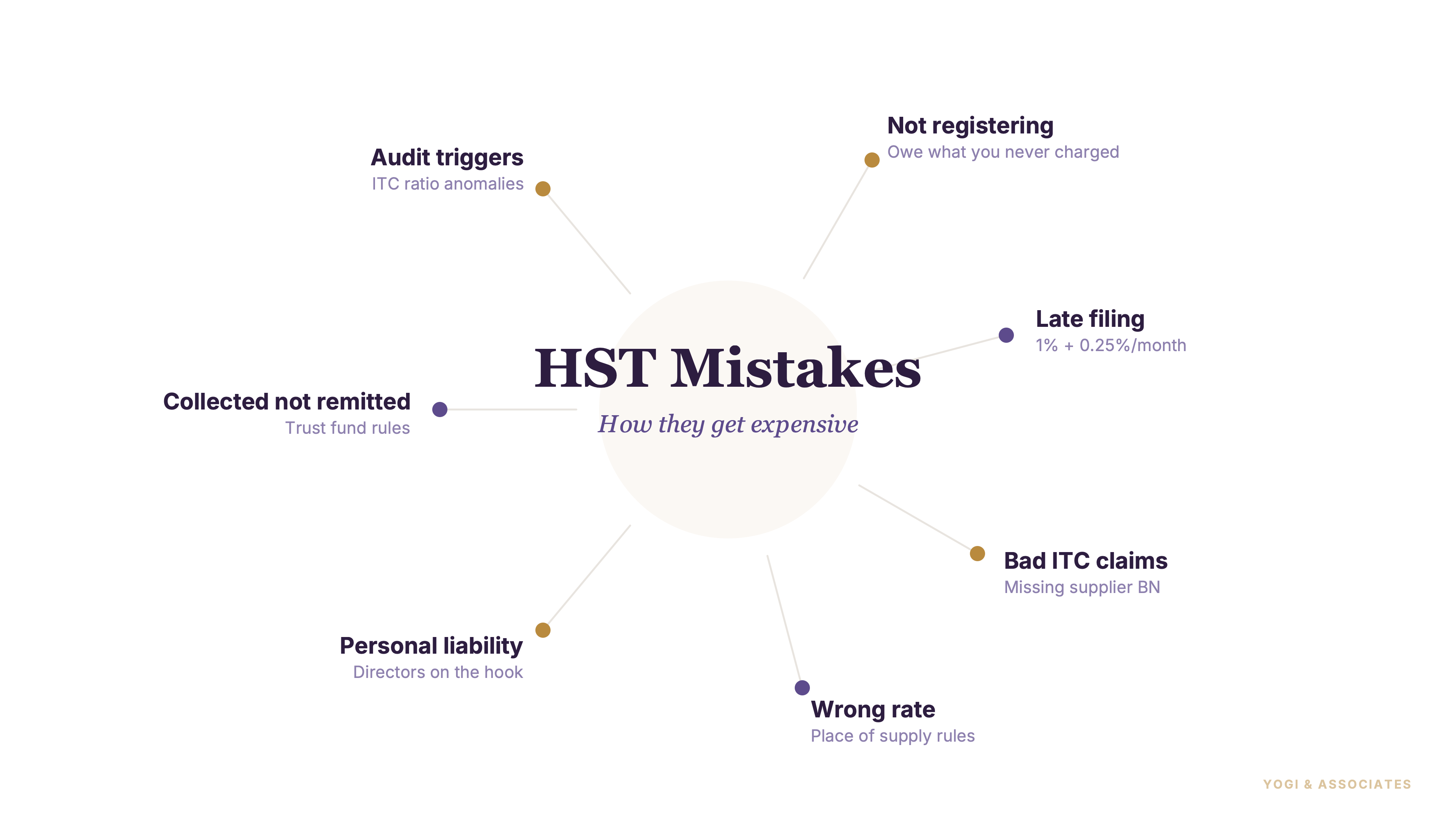
1. Late registration is not harmless
Ontario small businesses cross the $30,000 threshold and keep invoicing without HST more often than you would expect. A lot of owners treat late registration like a paperwork issue. CRA treats it like tax that should already have been collected.
If you should have registered and didn't, you still owe the GST/HST from your effective registration date. This is one of the nastiest mistakes in the category: the customer is gone, but the tax bill stays. And the customer is almost never willing to pay GST/HST after the fact on an old invoice.
If you're still unsure whether you crossed the line, read our GST/HST guide and our small supplier threshold guide before the problem grows legs.
2. Late filing and late payment
CRA's late-filing formula is explicit: 1% of the amount owing plus 0.25% of that amount for each complete month the return is late, up to 12 months. No discretion, no “just this once.”
Interest is separate. CRA charges interest on overdue balances at the prescribed rate, which resets every calendar quarter.
Most owners focus on the penalty and forget the interest keeps running in the background. Which is why small delays age badly — a 90-day delay looks cheap until the 12-month cap gets close.
3. Nil returns and bad records
Registered businesses have to file for every reporting period, even if there's nothing to report. Owners still skip nil returns because no activity feels like no filing. It isn't.
CRA also expects adequate books and records for at least 6 years from the end of the last tax year they relate to. Record problems often hurt more than the original mistake — they leave CRA room to estimate instead of verify, and estimates rarely land in your favour.
If your HST filings are already behind, our HST filing service is the cleanest way to stop digging. Waiting almost never makes it cheaper.
4. ITC claims that do not hold up
The most common ITC mess is bad support. CRA's documentary rules change by invoice size, and a missing supplier number can kill a claim that felt completely ordinary.
Mixed-use claims are another trap. You can only claim the commercial-use portion — personal use has to be carved out, not ignored. The “I mostly use it for business” answer isn't specific enough to survive a review.
This is where sloppy bookkeeping becomes expensive bookkeeping. Our ITC guide goes deeper on the receipt rules when you want the full version.
5. Charging the wrong HST rate
The right GST/HST rate depends on the place of supply — CRA's term for where a sale is considered to happen. That's not always where the seller sits.
A sale made in Ontario is 13% HST. The same service delivered to a Manitoba client is 5% GST. A US client can be zero-rated entirely. This is where online sellers and service businesses get burned: the rule sounds simple until the facts move across a provincial line.
If you sell across provinces, don't guess from your office address. Guessing here is one of the fastest ways to create a future reassessment you didn't see coming.
6. Fixing mistakes before CRA finds them
The Voluntary Disclosures Program (VDP) is CRA's path for coming forward before they contact you. If accepted, it can give relief from penalties and in some cases partial interest relief.
The disclosure has to be voluntary and real. VDP isn't meant to reward people who move only after CRA has already put a spotlight on the file — timing matters as much as the math.
This is the right path when the problem is old, clear, and still undiscovered. Our CRA audit support service is where that conversation usually belongs.
7. When HST becomes personal
Incorporation doesn't always wall off HST problems. Directors can be held jointly and severally liable under section 323 of the Excise Tax Act when a corporation fails to remit net tax.
Net tax is the GST or HST you collected minus the ITCs you can claim. This is the moment most owners finally understand: unremitted HST was never really their money in the first place. CRA treats it as tax held in trust for the government.
If the corporation is behind, don't assume the risk dies inside the company. Fixing it early is almost always cheaper than defending it later — especially if you're still a director when CRA catches up.
Not sure where your HST risk actually sits — is it late filings, a missed registration date, sketchy ITCs, or something that could already pin liability to you personally? We run a 30-minute HST risk triage for GTA owners: we tell you what CRA would flag first, what the real dollar exposure looks like, and what we can clean up before they notice.
Book a Free Consultation