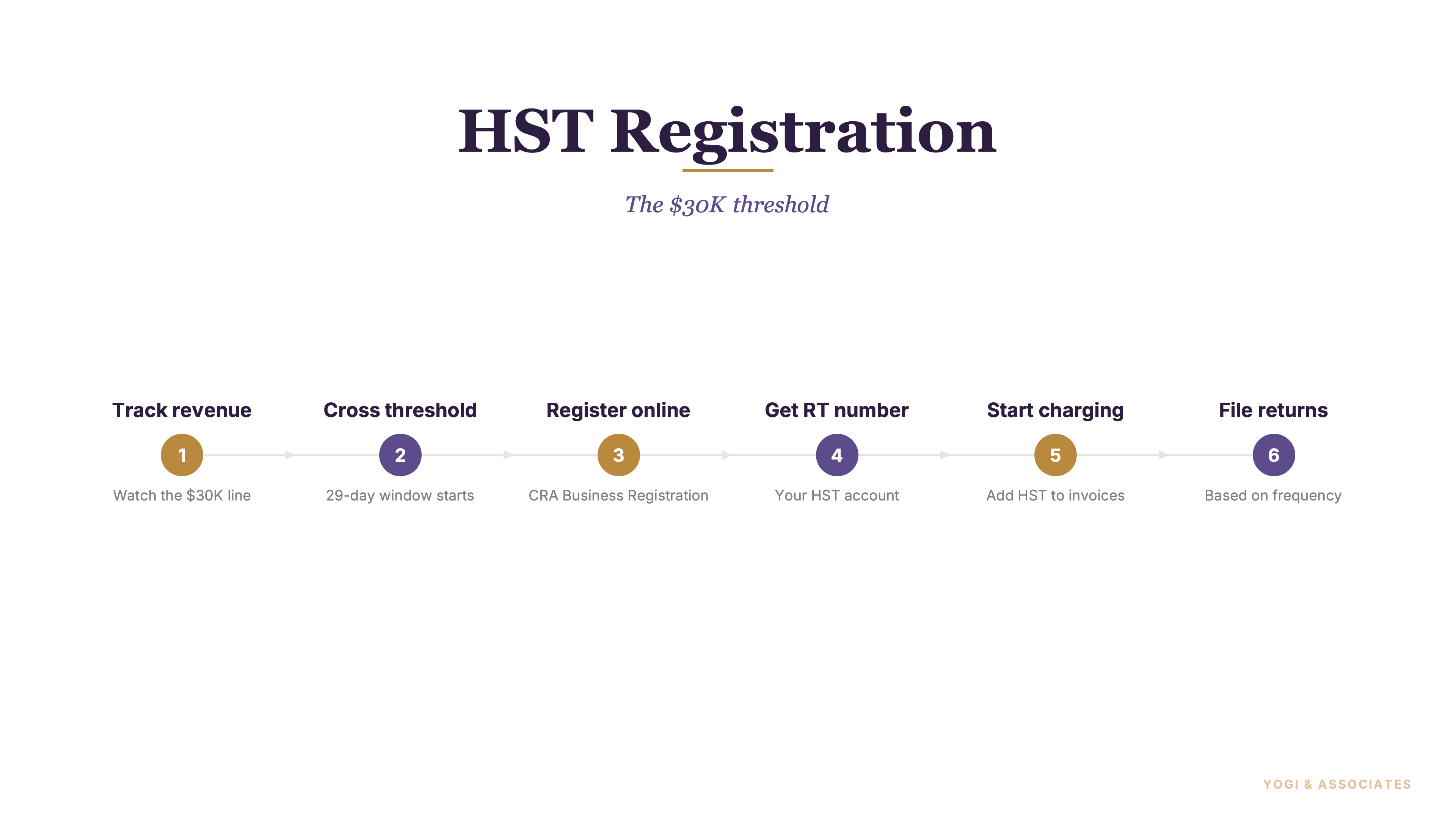
1. The $30,000 threshold
CRA calls you a small supplier as long as you stay under $30,000 in worldwide taxable revenues — including zero-rated supplies. Hit that line and the small-supplier protection ends.
The tricky part: there are two tests, not one. Either a single calendar quarter over $30,000, or four consecutive quarters over $30,000 combined. Cross either line and you're out.
If you're freelancing, consulting, or selling products in the GTA, track the threshold monthly. Our GST/HST pillar guide has the wider system in one place.
2. Exactly when registration starts
Cross $30,000 in a single quarter and small-supplier status ends immediately. CRA requires you to charge GST/HST on the very supply that pushed you over the line — not the next one.
The four-quarter test is slower. You stop being a small supplier at the end of the month after the quarter you went over, and your effective date is no later than your first supply after that.
Either way, you have 29 days from your effective date to register. That 29-day window is where most owners get hurt — they're still reading about the threshold when CRA's clock has already started.
3. When voluntary registration makes sense
You can register before you hit $30,000. The trade-off: you're now in the full GST/HST system early, which means charging tax, filing returns, and keeping receipts.
The upside is the input tax credit (ITC) — the GST/HST you paid on business purchases, claimed back on your return. Voluntary registration usually pays off when you have real startup costs or heavy ongoing GST/HST on expenses. It rarely pays off if you mostly sell services with low overhead.
Skip registration and you can't charge GST/HST, and you can't claim ITCs. So voluntary registration isn't about looking official. It's about whether the math works out for your business.
4. How to register with CRA
CRA handles most registrations online through Business Registration Online (BRO). If you don't already have a Business Number (BN), CRA issues one during the same session.
Before you log in, have these ready: business name, mailing and physical addresses, business type, main activity, annual worldwide and domestic GST/HST taxable sales, fiscal year-end, and the effective date of registration. Get the effective date right before you click anywhere — that's the field CRA won't casually let you change later.
Need the filing side handled after setup? Our HST filing service picks up from here.
5. What changes after you register
Registration changes your day-to-day the minute it's effective. You charge the correct GST/HST on taxable supplies, keep records that survive a CRA review, claim ITCs properly, and file returns on time.
In Ontario, that's 13% HST on taxable supplies. Selling into other provinces depends on where the supply is made — 5% GST in non-participating provinces, different HST rates elsewhere. Place of supply is its own rabbit hole, and it's the second-most-common place Mississauga and GTA owners get this wrong.
Many freelancers only run into GST/HST once the business income starts feeling real. Our self-employed tax guide covers that transition.
6. Filing periods and returns
CRA assigns your filing period by annual taxable supplies: annual up to $1.5M, quarterly up to $6M, monthly above that. Most new registrants start on annual, then switch to quarterly if cash flow or refund timing argue for it.
Our filing frequency guide goes deeper on when to elect a faster cadence, and our deadlines guide has the exact dates.
7. Late registration and cancelling later
Late registration is where this gets expensive. CRA can look back to the date you should have started charging, and you'll owe that tax even if the customer is long gone. Interest and penalties stack on top.
The upside: if you become a small supplier again after at least a year of registration, you can close the account with Form RC145. Don't just stop filing — that's how small problems become audit problems.
Not sure if you missed your effective date? We check this for GTA owners every week — we run the math, flag whether you're already late, and lay out the cleanest way to fix it before CRA finds out first.
Book a Free Consultation