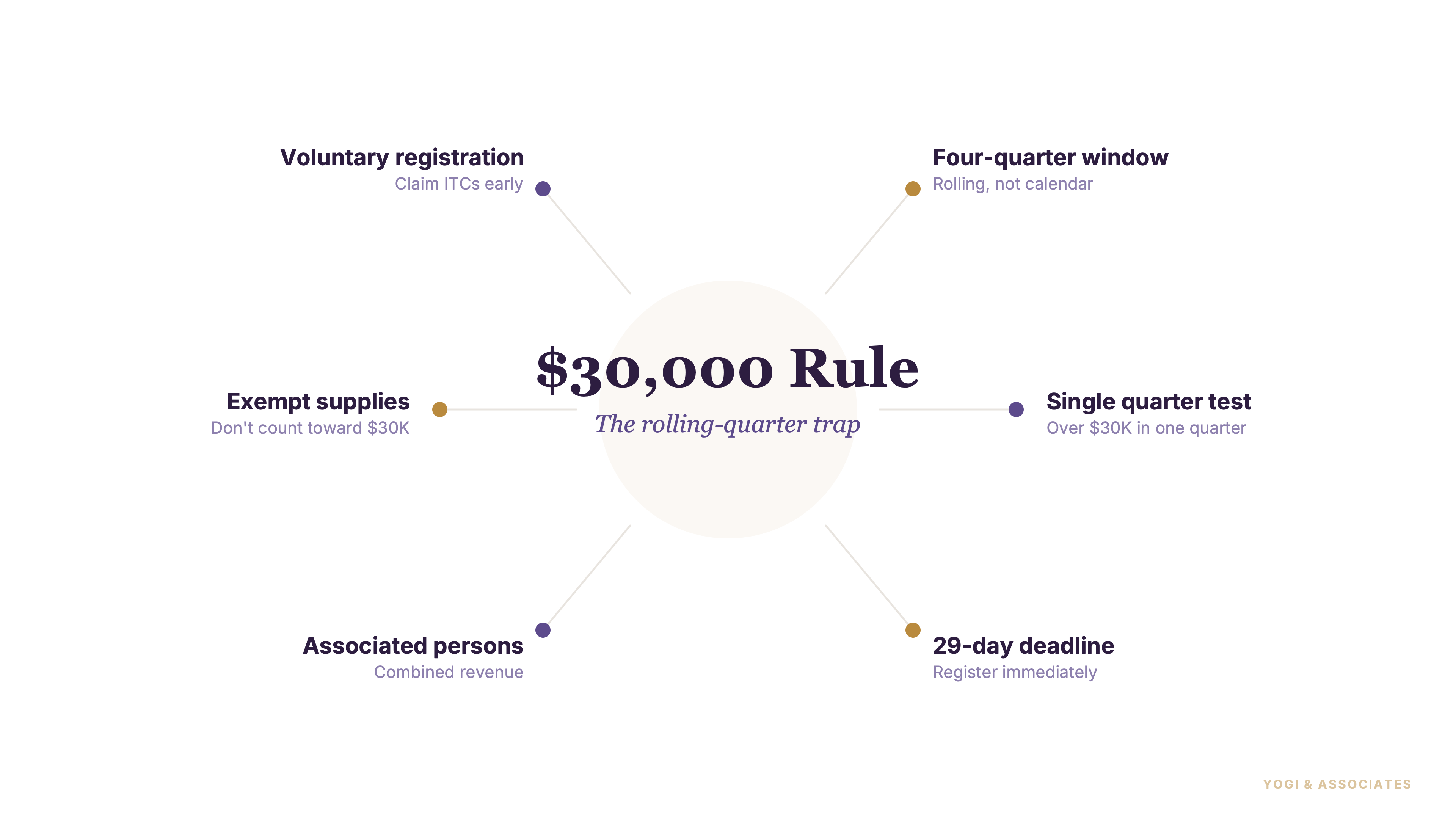
1. What the threshold really means
A small supplier is CRA shorthand for a business below the GST/HST registration limit. For most Ontario businesses, that limit is $30,000 and it arrives faster than you expect once clients start coming in.
The exact wording matters: “does not exceed.” At exactly $30,000 you're still a small supplier. One dollar over and you lose that status — the question is just when, depending on how you crossed it.
Our GST/HST guide is the broader map once you want the whole system laid out together.
2. What counts toward the limit
CRA counts worldwide taxable supplies, including zero-rated supplies. Zero-rated means the GST/HST rate is 0% — but the revenue still counts toward the threshold test.
Exported goods count. Other 0% taxable revenue counts. People see 0% and assume it means invisible. It doesn't.
This is the mistake service businesses rarely make and product businesses make often. If you sell internationally or to other registrants, track the zero-rated line separately so it doesn't sneak up on you.
3. What does not count
Exempt supplies don't count because they're not subject to GST/HST. CRA also specifically excludes goodwill from the sale of a business, supplies of financial services, and sales of capital property from the threshold calculation.
That matters more than people think. Owners often panic after a one-time asset sale even though CRA specifically excludes it from the threshold math.
Don't mix operating revenue with everything else sitting in the bank account. The threshold test is narrower than your deposits.
4. The associated persons rule
Associated persons is CRA's term for related businesses that share owners or control. When the rule applies, your numbers get combined for the threshold test.
No, you don't get a fresh $30,000 per side hustle just because the invoices come from different entities. This is one of the easiest ways owners fool themselves without meaning to — two businesses at $20,000 each feels safe, but combined it's $40,000 and you're already late.
Side businesses need to be reviewed together, not one by one. If you're already over and need the next step, read our GST/HST registration guide right after this.
5. The special $50,000 rule
Public service bodies — charities, non-profits, municipalities, school and hospital authorities, public colleges, universities — play by a different rulebook. Their threshold is $50,000, and the same rolling-quarter math applies. If that's you, skip the rest of this page and talk to us directly; PSB rules deserve their own review.
6. Two ways to lose small supplier status
There are two ways to go over the line. A calendar quarter is a three-month block beginning January, April, July, or October.
If you exceed $30,000 in a single calendar quarter, you stop being a small supplier immediately before the supply that put you over. You have to charge GST/HST on that supply — not the next one.
Or you can exceed $30,000 over four consecutive calendar quarters. That version is the real trap: it sneaks up on people, especially freelancers, because any one quarter can look fine on its own. Our self-employed tax guide often sits beside this one.
7. Tracking it and deregistering later
You need to look back at a rolling four-quarter window every quarter, not just at year-end. A simple revenue tracker beats heroic memory every time.
Once registered, you can ask CRA to cancel only if you're a small supplier again and you've been registered for at least one year. Small-supplier status here still ties back to the same $30,000 four-quarter test.
Small suppliers can also register voluntarily, usually to claim ITCs on real business costs. That makes the most sense when startup spending is meaningful. If ongoing compliance is the real pain point, our HST filing service is the cleanest next move.
Not sure if you're already past $30,000 on the rolling-quarter math — or if your side business just tipped you over via the associated-persons rule? We run the math for GTA owners every week and tell you straight whether you've been late for three months or fine for another two.
Book a Free Consultation