1. CRA does not pick files blindly
Ontario small businesses land on CRA's radar more often than most owners expect. CRA does not need a dartboard. It uses risk review methods, data matching, and comparisons against normal patterns to decide where to look harder.
That is where the industry benchmark (the average ratio CRA expects for your industry — they compare your return against thousands of similar businesses) idea matters. But owners usually miss it because they assume CRA only cares about obvious fraud.
That assumption is naive. Our bookkeeping guide is the broader fix, but the short version is simple: a file can look suspicious long before anyone proves intent.
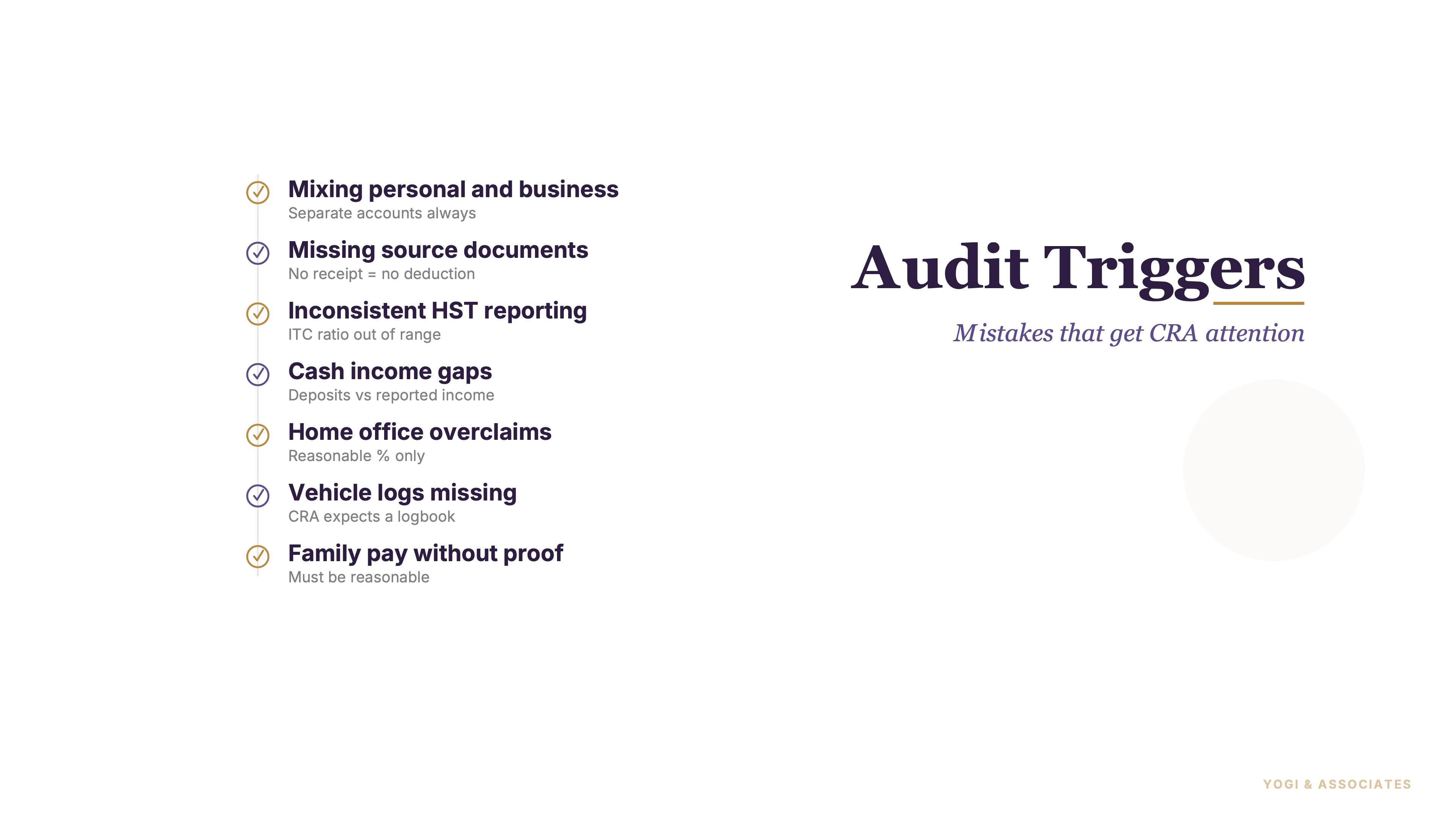
2. Mixing personal and business spending
This is still one of the most common problems in small business books. Personal meals, family travel, home groceries, and random household charges get pushed through the business account and coded as if they belong there.
CRA's business-expense rules only allow amounts that were incurred to earn business income. So once the general ledger starts looking personal, the whole category becomes easier to question.
this mistake is less about fraud and more about laziness. But it still gets treated like a real problem when the support is weak.
3. Income gaps, HST gaps, and round numbers
The books should tell one story across the return, the bank, and the HST filings. If they do not, questions follow.
So when reported income feels low compared with HST collected, or when the file is full of suspiciously neat round-number expenses with thin support, the books stop looking organic. We've found that fake-looking numbers often come from rushed cleanup, not careful bookkeeping.
This is why HST errors deserve their own attention. Our GST/HST mistakes guide is the right companion if the tax side of the file is already messy.
4. Missing records and weak support
Numbers without paper are just opinions. CRA expects the books to be supported by records.
That means receipts, invoices, contracts, bank records, and the rest of the support trail have to exist and make sense together. But when the file depends on missing slips, vague notes, or bank lines with no supplier detail, the expense becomes much easier to deny.
this is the quiet trigger owners underestimate most. Our receipt management guide matters here because the audit fight is usually won or lost before the audit starts.
5. Vehicle, home office, and repeated losses
These are normal claims, but they need real backing. Vehicle expenses need a logbook, and home office claims need a defensible business-use calculation.
Repeated losses create a different kind of problem. So if the business loses money year after year and there is no credible path to profit, CRA can start asking whether this is really a business at all under the reasonable expectation of profit (a CRA test for whether an activity is a real business or just a hobby — losing money for years with no plan to profit fails the test) idea.
Owners should treat these areas as evidence-heavy from day one. they are easy to claim casually and hard to defend casually.
6. Cash deposits and late filings
Big unexplained deposits make people nervous for a reason. If money hits the bank and there is no invoice, loan paper, or owner contribution note behind it, the file starts to look incomplete fast.
Late or missing filings send a different signal. But they also tell CRA the internal controls may be weak, which makes deeper questions more likely.
We've found this is where clean reconciliations save people. Our bank reconciliation guide helps because unexplained cash movement usually shows up there before it shows up in an audit letter.
7. Fix it before CRA does
If the books are wrong, silence is not a plan. The longer the problem sits, the more expensive it usually becomes.
CRA's Voluntary Disclosures Program (VDP — a CRA program where you fix past mistakes voluntarily in exchange for reduced penalties, usually before CRA contacts you) exists for exactly this kind of situation. But the disclosure has to be voluntary, complete, and involve information that is at least 1 year overdue or carries a penalty risk.
Owners wait too long to use it. If the file already makes you nervous, our CRA audit support service is the right next step before CRA is the one asking the questions.
Messy books do not always become an audit, but they do make one harder. If you want the file cleaned up before CRA looks at it, we can help.
Book a Free Consultation