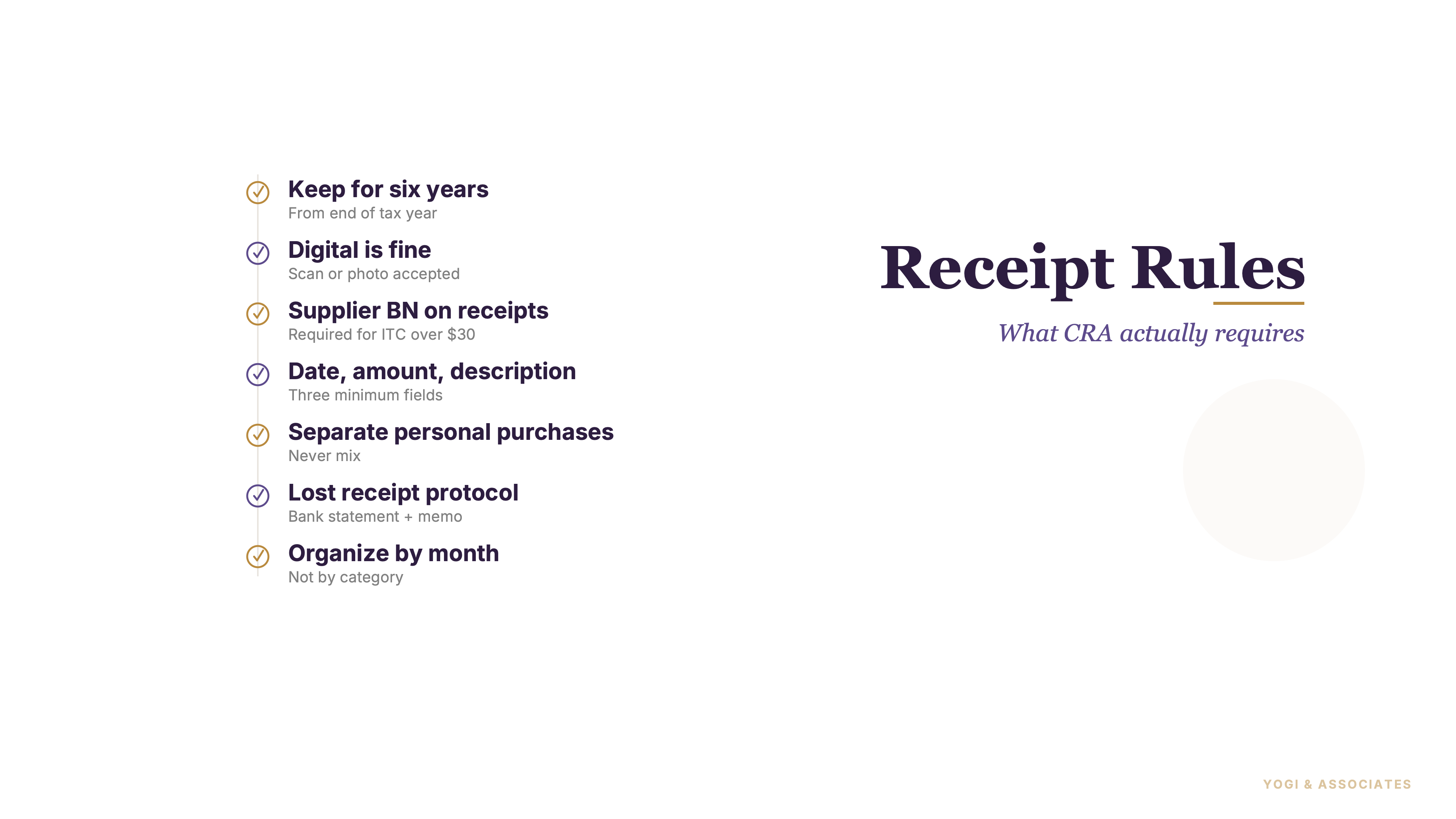
1. Start with the record-keeping rule
CRA's baseline rule is not complicated, but owners ignore it constantly. Records generally have to be kept for at least six years from the end of the last tax year they relate to.
And that clock can move if you file late. CRA says that if a return is filed late, the six years runs from the date you filed.
This one rule should shape your whole filing system. Our bookkeeping guide is the bigger framework, but receipt management starts with accepting that the paper trail has to outlive your memory by a long margin.
2. Paper versus digital records
Digital is fine if it is done properly. CRA accepts electronic records, including scanned images and electronic documents, as long as they are clear, legible, complete, and can reproduce the original information accurately.
But digital is not a magic word. people think snapping a blurry photo counts as record-keeping when it really counts as future disappointment.
Apps like Dext, Hubdoc, and mobile capture tools are useful only if someone still checks the image quality and naming. And CRA also expects the records to be available in Canada when requested, which matters if you rely on cloud storage without understanding where the data sits.
3. Receipts and invoices are not the same thing
Owners mix these up all the time. An invoice asks for payment, while a receipt proves payment happened.
Both can support a file, but they do different jobs. So if you are claiming HST, the invoice usually matters more because it may contain the supplier details and registration number needed to support the claim.
This is why businesses should store the whole document trail, not just the card slip. Our monthly bookkeeping checklist is helpful here because document filing should be part of every month-end, not a once-a-year scramble.
4. ITC documentation is stricter than most owners think
This is where CRA gets specific. For GST/HST ITCs, the information you need depends on whether the amount is under $30, $30 or more but less than $150, or $150 or more.
Once the amount reaches $30, you need more supplier information, including the supplier's GST/HST registration number. And once the amount reaches $150, CRA expects a fuller set of supplier and transaction details.
this is the part most small businesses get wrong. Owners should stop treating every receipt like it carries the same weight, and our ITC guide is the next read if you want the tax-credit side explained properly.
5. What to do when a receipt is gone
First, do not pretend it never existed. That just creates a bigger problem later.
Ask the supplier for a duplicate if you can. But if you cannot get one, rebuild the transaction using your bank record, credit card record, emails, and notes, and understand that the support may still be weak if CRA ever asks questions.
We've found the bank record is better than nothing, but not nearly as strong as the original supplier document. that gap matters most when someone tries to support an ITC claim with only the payment proof.
6. Special records like logbooks matter too
Receipts are not the whole story. Some expenses need a second layer of proof.
Vehicle claims are the classic example. CRA expects a logbook (a written record of every business trip you make in your vehicle, with dates, distances, and purpose), and it also allows a simplified logbook method using a 12-month base year and a 3-month sample in later years if the conditions are met.
This is where people get too casual. The thing is, fuel receipts alone do not prove business use, and no amount of confidence fixes a weak mileage record later.
7. What a CRA review actually feels like
A CRA review is usually not dramatic. It is detail work.
CRA's own review and audit guidance says records must support every amount on the return, and reviewers may ask for selected receipts, invoices, bank statements, ledgers, contracts, and explanations tied to specific line items. So the pain usually comes from retrieval, not from the theory.
Businesses should prepare for reviews long before one starts. If you want help building the file or surviving the questions, our CRA audit support service exists for exactly that reason, and our GST/HST mistakes guide shows what weak support can turn into.
Receipt management feels minor until CRA asks for proof. If you want the record trail cleaned up before that happens, we can help.
Book a Free Consultation