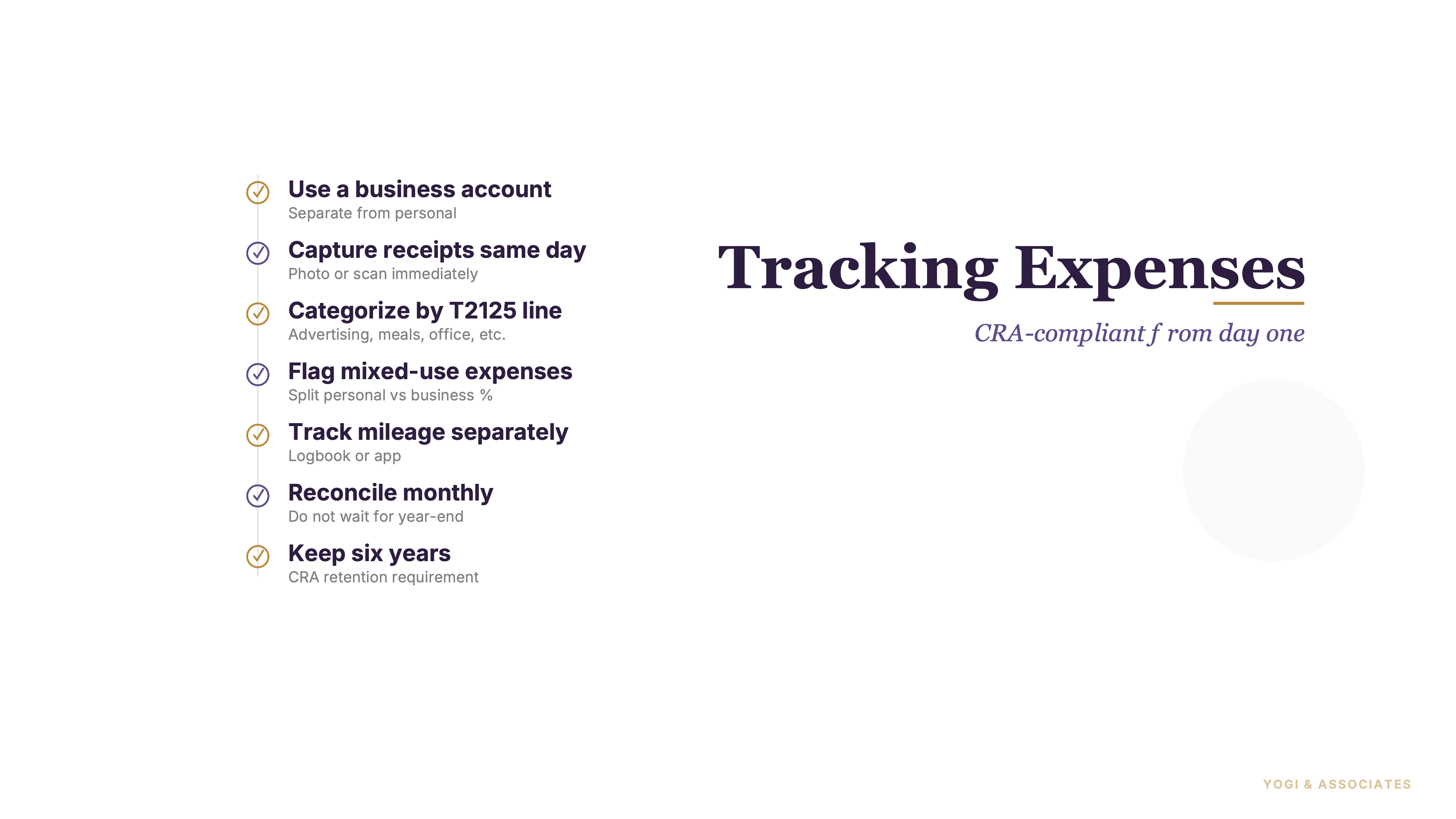
1. Start with the right buckets
Most bad tracking starts with bad categories. If the books are not organized around the right buckets, year-end becomes a guessing exercise.
CRA's T2125 categories give you the structure. So track obvious items like line 8521 advertising, line 8523 meals and entertainment, line 8810 office expenses, line 8860 professional fees, line 8910 rent, line 9200 travel, line 9281 motor vehicle expenses, and line 9936 CCA in consistent places all year.
Owners should build the chart around the return before transactions pile up. Our deductions guide covers what can be claimed, but this post is about making sure the tracking is clean enough to survive review.
2. Track it when it happens, not months later
The closer you track the expense to the date it happened, the better the file holds together. Waiting until quarter-end or year-end is how categories get guessed and details get lost.
And the standard for the expense is not just whether it happened. CRA also cares whether the amount was reasonable in the circumstances for that business.
Monthly coding beats heroic catch-up every single time. people do not forget the amount first. They forget why it was business in the first place.
3. Keep the support behind every number
This is the part nobody enjoys, but it is the part CRA cares about most. Every claimed expense needs support.
That means a receipt or invoice with the supplier, the date, the amount, and what was purchased. But for ITCs, the support gets stricter once the amount reaches $30 and then again once it reaches $150, because supplier tax details become more important.
This is where good files separate themselves from messy ones. Our receipt management guide goes deeper on the document side because weak support turns a valid expense into an avoidable fight.
4. Handle mixed-use expenses properly
Mixed-use costs are where owners get overly optimistic. Vehicle and home office claims are the classic examples.
For vehicle costs, use a logbook (a written record of every business trip you make in your vehicle, with dates, distances, and purpose) and calculate the business-use percentage from business kilometres over total kilometres. But for home office, CRA wants either a principal place of business or exclusive and regular client-use test, then a space-based calculation.
Owners should assume these categories need extra proof, not less. mixed-use expenses are the easiest to overclaim and the easiest for CRA to cut back.
5. Watch the special rules that trip people up
Some categories look simple but have traps built in. Meals and entertainment are the obvious one.
CRA puts meals and entertainment on line 8523, and the usual rule is that only 50% is deductible. So if you track restaurant spending lazily, you make the return harder before the accountant even starts.
Foreign-currency expenses need care too. Owners should convert them to Canadian dollars right away using a consistent supportable rate, with Bank of Canada rates as the clean default when needed.
6. Use tools without getting lazy
Software helps, but it does not think for you. QuickBooks and Xero can pull bank feeds, while tools like Dext and Hubdoc can capture receipt images and push data into the books.
But an app only speeds up the workflow. owners get into trouble when they assume OCR guessed the supplier, the tax, and the category correctly every time.
Software should remove typing, not remove review. Our self-employed taxes guide helps show where the tracked categories eventually land on the return.
7. Avoid the coding mistakes that get expenses denied
The common mistakes are boring. Personal card charges mixed into the books, cash transactions with weak details, vehicle costs without logs, and expenses dumped into random categories because the owner was in a hurry.
So keep business and personal spending as separate as possible, code cash transactions with the same discipline as card transactions, and review the books monthly before the errors harden. But do not confuse convenience with compliance just because the software accepted the entry.
Bad tracking causes more denied expenses than aggressive tax positions do. If you want the books reviewed monthly instead of repaired later, our bookkeeping guide and our bookkeeping service are the right next stops.
Tracking expenses is easy to underestimate and expensive to clean up later. If you want the books set up properly for CRA from the start, we can help.
Book a Free Consultation