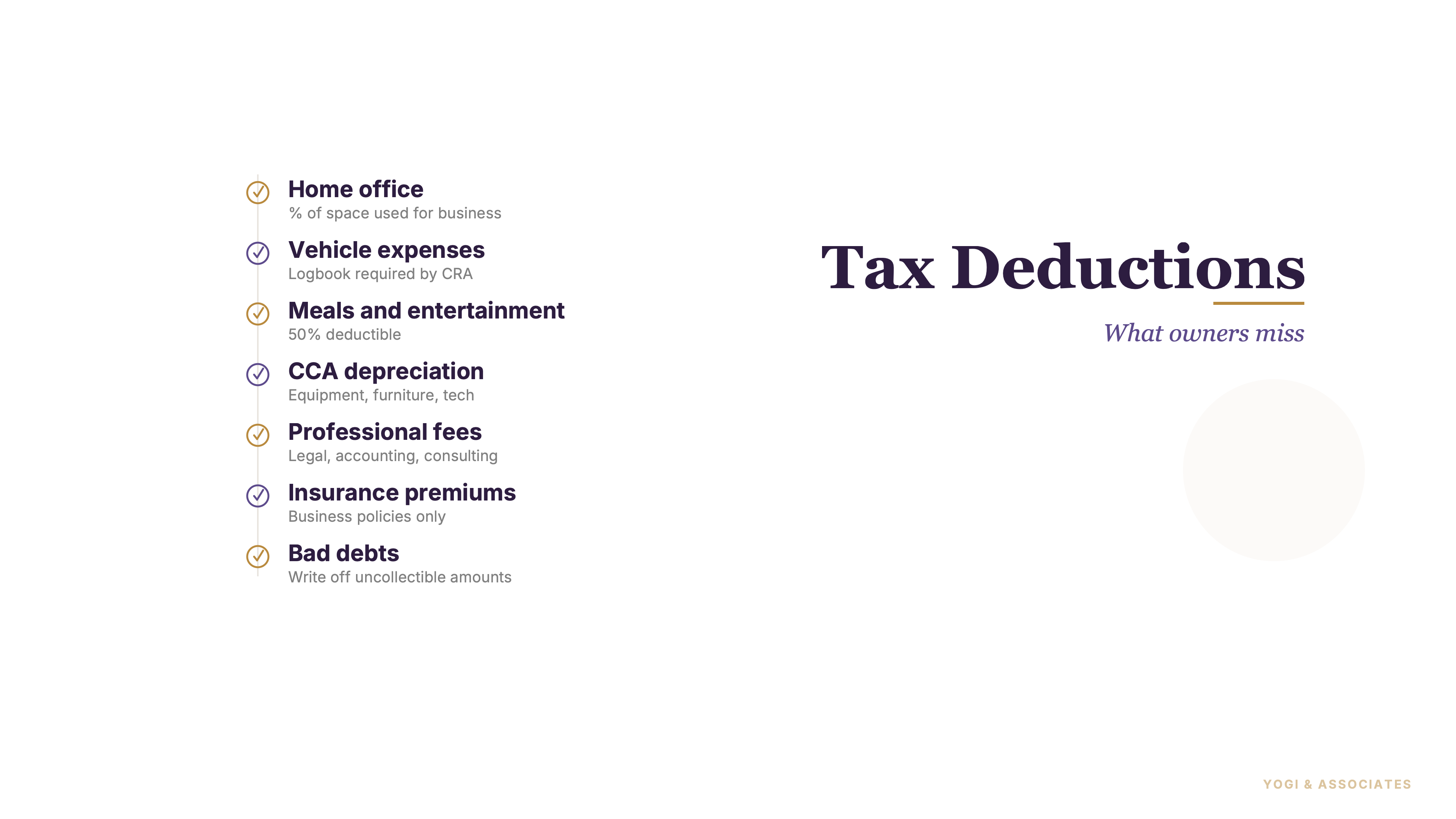
1. What actually counts as a deduction
Ontario small business owners leave money on the table every year because they are not sure what qualifies. The CRA's rule on business expenses is simpler than people think. To be deductible, the expense has to be incurred to earn business income, and it has to be reasonable in the circumstances.
That's it. Two tests.
But “reasonable” is where owners get nervous. A $60 client lunch is reasonable. A $600 client lunch on a Tuesday with no business discussion is not.
The CRA doesn't publish a menu of approved vendors — they look at the pattern.
the owners who get audited hard aren't the ones claiming a home office. They're the ones claiming personal expenses as business and hoping nobody notices. Keep the two worlds separate and most of this gets easier.
- Reasonable and business-related — the cost helped you earn revenue or run the business.
- Documented — receipt, invoice, or bank record. CRA wants to see six years of backup.
- Not personal in disguise — groceries, family vacations, and personal clothing don't count just because they hit the business card.
2. Home office expenses
If you run your business from home, this is usually the biggest missed deduction. And it's also the one owners are most afraid to claim. We get it — people remember a news cycle about home office audits and decide it's not worth the risk.
It is worth it. You just have to do it properly.
For self-employed owners filing a T2125, the detailed method works off floor area. You take the square footage of the space you use for business, divide it by the total square footage of your home, and apply that percentage to eligible home costs.
So if your office is 150 sq ft in a 1,500 sq ft home, you're at 10%. That 10% applies to utilities, rent, home insurance, property taxes, and reasonable maintenance. Not the whole bill — just your business share.
Two hard limits. You can't deduct the principal portion of your mortgage payment. And the home office claim can't push you into a business loss — any unused portion carries forward to a future year when you have income to absorb it.
Most people get this wrong because they either skip it entirely or try to claim 50% of a room they also use as a guest bedroom. The CRA wants the space to be used for business on a regular and continuous basis.
A dedicated room is cleanest. A shared space with an honest percentage is fine. A guest room that sees business email once a week is not.
3. Vehicle and mileage
Vehicle is the other big one. And it's also the category where we see the most overclaiming — usually not on purpose. The owner drives to one client meeting a month and then writes off 100% of the lease.
Here's how it actually works. You track your total kilometres for the year and the kilometres driven for business. Business divided by total gives you your business-use percentage.
That percentage is what you apply to actual vehicle costs: fuel, insurance, maintenance, lease payments, and CCA if you own it.
No log, no deduction. Or more accurately: no log, and the CRA can slash your claim to whatever they think is reasonable, which is usually a lot less than you wrote down.
For 2026, the CRA's tax-free allowance rate for employees using a personal vehicle is 73 cents per kilometre for the first 5,000 km in the provinces, and 67 cents per km after that. Territories are a few cents higher. That's the reimbursement rate employers can pay without creating a taxable benefit — not a flat deduction you claim on your own return, but it's the number people ask about most.
If you're self-employed, you deduct actual costs on your business-use percentage. If your corporation owns the vehicle, different rules apply again — we walk through the tradeoffs in our tax preparation guide.
4. Meals and entertainment
The 50% rule. You've probably heard of it. But a surprising number of owners still try to write off 100% of a client dinner and then get trimmed back at year-end.
Under Section 67.1 of the Income Tax Act, most business meals and entertainment are only 50% deductible. That covers client lunches, meals while travelling for work, and food at business conferences. The same 50% cap applies to the HST portion — you only get half of the input tax credit.
So on a $100 client dinner with $13 HST, you're deducting $50 of the food and claiming $6.50 of HST back. Not $100 and $13.
There are exceptions. Office parties open to all employees are 100% deductible, up to six events per year. If you're in the food business and buying meals as inventory, those are obviously full cost.
Long-haul truck drivers get 80%. Beyond that, plan on 50% and don't let a client talk you into “my accountant claims the whole thing.”
And one we say constantly: gift cards, lottery tickets, and LCBO runs for clients are promotion, not meals. Different category, same 50% trap if it's tied to entertainment.
5. Equipment and CCA
Capital cost allowance (CCA) — the CRA's way of letting you write off equipment over time instead of all at once. If you bought a laptop, a desk, or a vehicle for the business, you don't get to deduct the whole amount in year one. You claim a percentage each year based on the class the asset falls into.
CCA is the deduction owners overcomplicate the most — it's not as scary as the form makes it look.
The classes most small businesses touch are pretty narrow:
- Class 8 (20%) — general furniture, fixtures, and equipment that doesn't fit another class. Desks, shelving, tools over $500.
- Class 10 (30%) — most motor vehicles used for business, up to a cost limit.
- Class 10.1 (30%) — passenger vehicles that cost more than the CRA's annual threshold. Separate class per vehicle, no terminal loss.
- Class 12 (100%) — small tools, software, kitchen utensils, and items under $500. Full write-off in year one.
- Class 50 (55%) — computers, laptops, and systems software for them.
One important 2026 note. The temporary $1.5 million immediate expensing rule for CCPCs ended on December 31, 2023. The unincorporated-business version ran through December 31, 2024.
So if you're buying equipment today, you're back to regular CCA rates by class — not full write-off in year one.
The half-year rule also applies: in the year you buy the asset, you can only claim half your normal CCA amount. It sounds like a small detail, but it's the reason your accountant's depreciation number looks “wrong” the first year you buy something.
6. The deductions owners keep missing
After 25+ years of doing this, here's our running list of stuff that sits on personal credit cards and never makes it onto the T2 or T2125. These are boring. They're also real dollars.
- Phone and internet — a reasonable business-use percentage of your cell bill and home internet is deductible. Not 100% unless you really have a dedicated business line.
- Software subscriptions — QuickBooks, Shopify, Canva, Google Workspace, Zoom. Monthly fees are fully deductible in the year paid.
- Professional fees — bookkeeping, accounting, legal fees related to the business, incorporation costs. All deductible.
- Bank and interest charges — business bank fees, credit card merchant fees, and interest on business loans or a business line of credit.
- Insurance — commercial general liability, professional liability, contents and cyber insurance. Not personal life insurance — that's a different conversation.
- Continuing education — courses and certifications that maintain or update skills for your current business. Not courses for a brand-new career.
- Home office supplies — printer ink, paper, pens, a second monitor. Small, but they add up.
And here's the pattern we see every tax season. The owners who actually capture all of this are the ones running clean bookkeeping month-by-month. Not the ones scrambling in April.
If the expenses aren't sitting in a clean ledger by year-end, some of them will just quietly disappear.
Want a hand getting the books clean before filing? Take a look at our bookkeeping service or, if you're already behind, CRA audit support. And for the bigger picture, the parent guide on tax preparation in Canada ties all of this together.
Owners trying to figure out how to pay themselves should also read our post on salary vs dividends in Ontario.
Not sure which deductions apply to your business — or worried you've been missing them for years? We sort this out for owners every tax season. Let's look at your file before you file.
Talk to us about corporate tax