1. What an ROE actually does
Every Ontario employer with staff needs to know this form. An ROE is not just a payroll admin form. Service Canada uses the information on it to decide whether a person qualifies for EI, what the benefit amount will be, and how long benefits can be paid.
That is why the stakes are higher than many owners expect. Employers often treat the ROE like a smaller cousin of the T4, but it is a different document with a different job.
So if you want the broader payroll foundation first, start with our Canadian payroll guide. But do not confuse the ROE with a year-end slip like the one in our T4 guide, because the timing and purpose are completely different.
2. Know when an interruption of earnings happens
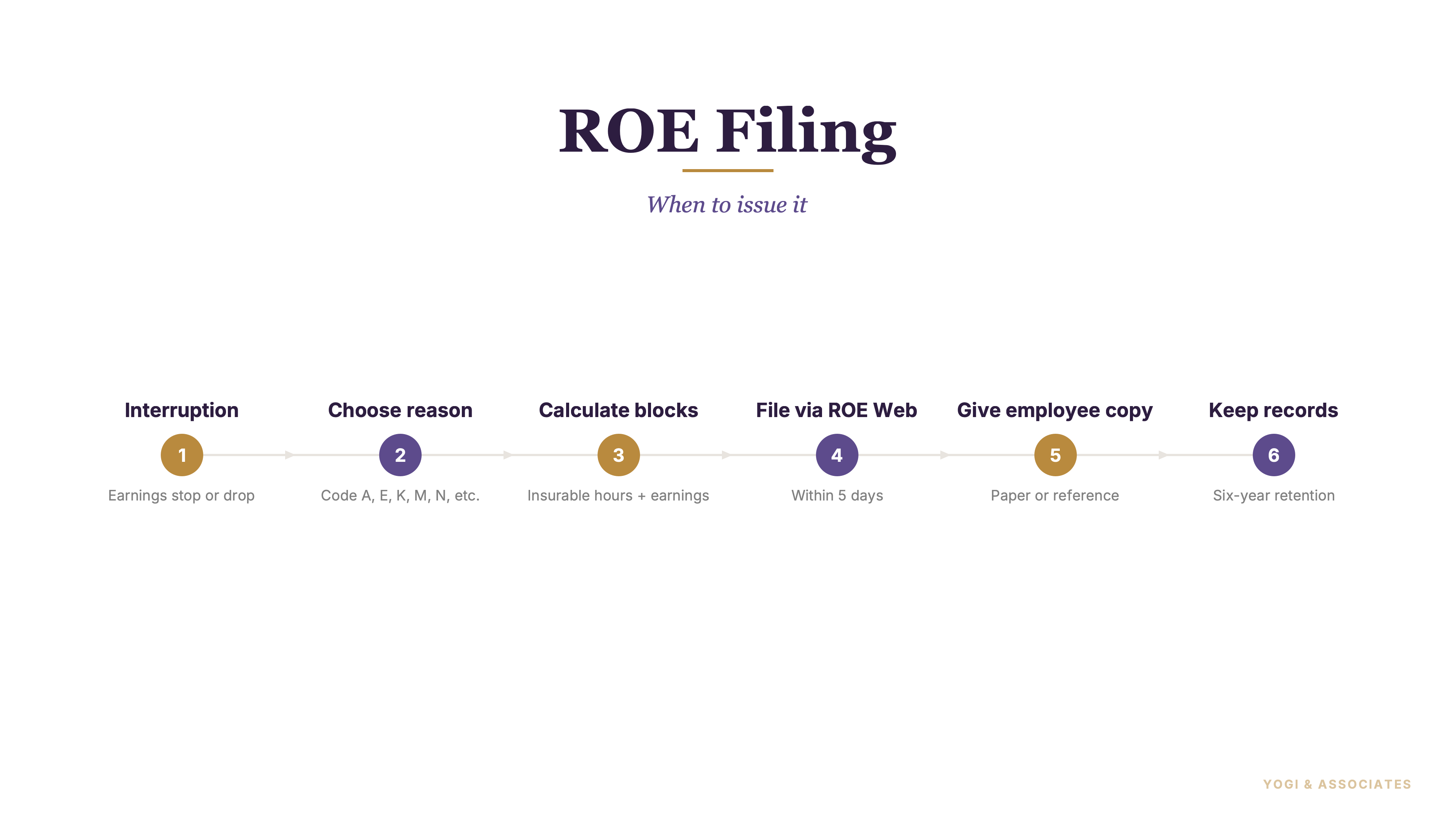
Service Canada says you must issue an ROE each time an employee experiences an interruption of earnings. Interruption of earnings (Service Canada's term for any 7+ day gap in pay caused by layoff, dismissal, quit, leave, or termination) is the trigger that matters.
That usually includes layoff, dismissal, quit, injury, illness, pregnancy, adoption leave, leave without pay, or another break where employment income stops. This is the part employers wait too long to assess, especially when the employee might come back later.
But the ROE decision is about the interruption, not your hopes about the relationship. So if the facts point to an interruption of earnings, treat it seriously right away.
3. Paper and electronic ROEs have different deadlines
The paper rule and the electronic rule are not the same. For a paper ROE, the deadline is within 5 calendar days after the first day of the interruption of earnings or the day you become aware of the interruption, whichever is later.
For an electronic ROE, the general deadline is 5 calendar days after the end of the pay period in which the interruption of earnings occurs. This is the deadline most employers should memorize, because late ROEs create stress fast for both the employer and the employee.
So if EI is about to become part of the employee's next step, our EI premiums guide is the natural companion read. And if payroll deadlines keep becoming last-minute fire drills, our payroll service is built for exactly this type of cleanup.
4. ROE Web is now the normal route
Most employers now handle ROEs electronically through ROE Web. ROE Web (the Service Canada online portal where most employers now submit ROEs electronically) is the system Service Canada points employers to for creating and submitting ROEs online.
Paper ROEs still exist, but they are not the path most employers should be building around anymore. The safer habit is to treat ROE Web as the standard process unless you have a very specific reason not to.
And once you file electronically, you do not need to hand over a paper copy just to be safe. But you still need the data inside the ROE to be right.
5. The key ROE blocks are not optional details
If you only remember four ROE blocks, remember these. Block 15A is total insurable hours, Block 15B is total insurable earnings, Block 15C is the pay-period breakdown of insurable earnings, and Block 16 is the reason for issuing the ROE.
Service Canada says Block 15A is based on the employee's insurable hours for the period used on the ROE, generally the last 53 weeks or since the last ROE if the period is shorter. Block 15B captures total insurable earnings, generally for the last 27 pay periods or since the last ROE if that period is shorter.
Plus Block 15C shows the insurable earnings by pay period, with the first entry tied to the final most recent insured pay period. These blocks deserve a second review every time, because once the hours and earnings are wrong, the rest of the form is usually wrong too.
6. Reason codes matter more than employers think
Block 16 is where you tell Service Canada why the ROE exists. Code A is for shortage of work, end of contract, or end of season. Code D is for illness or injury.
Code E is for quit. Code M is for dismissal or suspension. Code N is for leave of absence.
Code K is for other, and Service Canada says to use it only in exceptional circumstances. Reason-code mistakes are one of the worst ROE errors, because the code tells the story before anyone reads your notes.
So choose the code that matches what actually happened, not the one that feels least awkward. In our view, Code A and Code E are the pair employers confuse most when an employee's exit was messy.
7. The usual ROE mistakes are very avoidable
Service Canada guidance points to the same pattern again and again. Employers file late, use the wrong reason code, miss insurable hours or earnings, or break out the pay periods incorrectly.
And the guidance is pretty direct about the details: the ROE should include insurable earnings up to and including the last day for which the employee was paid, the first entry in Block 15C should be the final most recent insured pay period, and you should not include hours already reported on a previous ROE. These are boring errors, but expensive ones.
So do one calm review before you hit submit. In our view, most ROE problems are not legal mysteries. They are rushed payroll mistakes.
ROEs usually show up when the employee situation is already stressful enough. If you want the payroll side handled properly and on time, we can help.
Book a Free Consultation