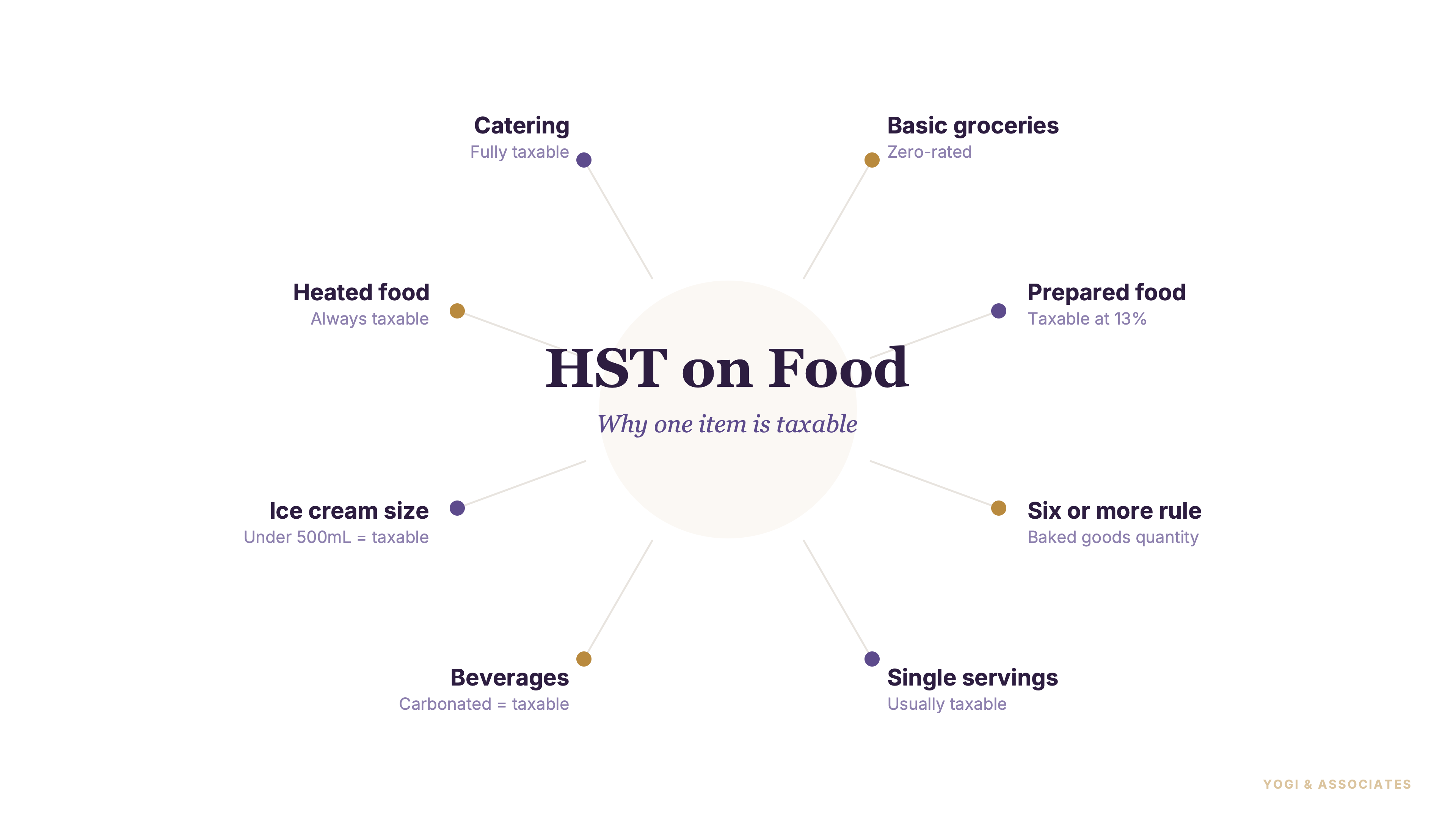
Most Mississauga food owners don't call us because one rule looked confusing on paper. They call when the POS, menu, and shelf tags are giving three different tax answers. And once that happens, you need to check the setup item by item.
1. The basic grocery rule
CRA starts with one big idea: most food and beverages sold for human consumption are zero-rated as basic groceries. Zero-rated means taxable at 0% — the customer pays no tax, but the seller can still claim ITCs on related business costs.
That's different from exempt. Exempt means no tax is charged AND the seller can't claim ITCs on related costs. The words sound the same; the math is very different.
This distinction matters more than most owners realize. For a food business, it changes both the receipt and the back-office ITC math every day.
2. Restaurants vs grocery stores
The same food item can land in a different tax bucket depending on where and how it's sold. A plain bagel sold as a grocery item is zero-rated. CRA specifically gives the example of a bagel or plain croissant sold in a restaurant as taxable.
In Ontario that's the full 13% HST. Which is why owners get tripped up when they compare restaurant takeout to grocery-store food without checking the establishment rule.
If you operate a restaurant, café, or prepared-food counter, don't assume grocery rules save you. Our restaurant industry page is the practical next read once food tax stops being theoretical.
3. Ontario's $4.00 prepared food rebate
Ontario runs a point-of-sale rebate. The province gives back the 8% provincial part of HST automatically at the till, so the customer only pays the 5% federal part on the affected items.
The rebate is narrow. It applies to qualifying prepared food and beverages sold for a total of $4.00 or less, ready for immediate consumption.
This rule gets butchered in practice because people remember the $4.00 number and forget the word “qualifying.” Some prepared food fits. Not every food item under $4.00 does.
4. Snacks, candy, and single servings
Snack foods are taxable. CRA lists chips, candies, fruit bars, granola bars, cookies, doughnuts, brownies, and similar snack products in the taxable bucket — no matter how the packaging is marketed.
Single-serving rules are where it gets messy. Single servings of ice cream under 500 mL or 500 grams are taxable. Single servings of yogurt or pudding under 425 grams are taxable. Sellers miss this because the product itself feels like a grocery item.
Larger formats and multi-item grocery-style sales land differently. Same product, same ingredient list — different shelf format, different tax result. Check the matrix above if you're not sure where a specific SKU lands.
5. Juice, soft drinks, and milk
Beverage rules are where people guess the most. Non-carbonated fruit juice beverages with less than 25% natural juice are taxable regardless of size. Non-carbonated fruit juice beverages with 25% or more natural juice can be zero-rated. So “fruit drink” and “fruit juice” look identical to a customer but land in different tax buckets.
Soft drinks and carbonated beverages stay taxable. Milk and most milk-based beverages, including flavoured milk, are zero-rated. Still water is a basic grocery; sparkling is a carbonated beverage.
Packaging matters here too. Drinkable yogurt under 600 mL is taxable. Larger grocery-style quantities can land differently. The juice percentage, the size, and the fizz each change the answer independently.
6. Alcohol and catering
Alcohol is the easy one. Beer, wine, spirits, malt liquor, and other alcoholic beverages are always taxable.
Catering is usually taxable too, even when the same food might have been zero-rated if sold as basic groceries in another context. This is the cleanest example of why service format — not the food itself — changes the tax result.
If your business switches between grocery sales, prepared platters, and full event service, don't lump them together in the POS. Our GST/HST registration guide helps if you're still cleaning up the wider setup around those sales.
7. Why food sellers still get this wrong
Food tax looks simple until one detail changes. Hot versus cold. Restaurant versus grocery. Single serving versus multi-pack. 25% juice versus less than 25%. Any one of those flips the answer, and most POS systems can't tell on their own.
The safest habit is building tax logic by category and SKU, not by memory. Once you're registered you still need the input-tax side right too — which is why our ITC guide matters just as much as the customer-facing rule.
If you sell food in Ontario, treat your menu and your shelf as tax documents. Our GST/HST pillar guide is the wider reference point when you need the whole picture in one place.
Food tax errors start small and get expensive fast — usually when the POS has been wrong for six months before anyone notices. We review menus, POS category mapping, and HST setup for Mississauga cafés, takeouts, and prepared-food sellers every week. Item by item, SKU by SKU.
Book a Free Consultation