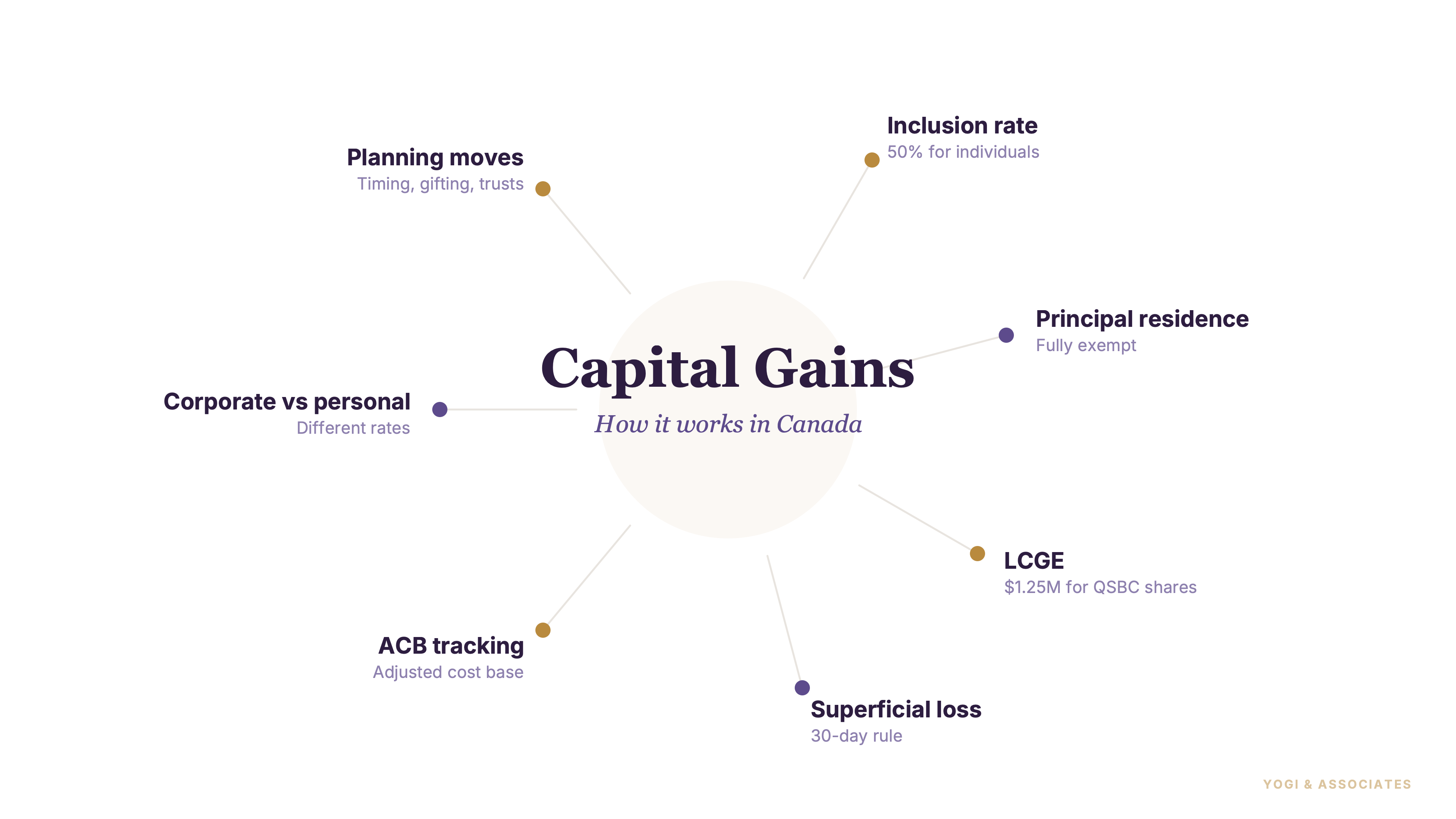
1. How capital gains tax actually works
A capital gain happens when you sell something for more than it cost you. For Ontario residents, that gain gets taxed at both the federal and provincial level, and the combined rate at the top bracket sits around 53.5%. That “something” could be a stock, a rental property, a cottage, crypto, or shares in a private corporation. The tax hits when you sell — not while the value goes up on paper.
Two numbers matter. Your adjusted cost base (ACB) — what you originally paid plus any capital improvements or transaction costs. And the proceeds of disposition — what you sold it for, net of selling costs.
Subtract ACB from proceeds and you get your capital gain. Only a portion of that gain — called the taxable capital gain — actually gets added to your income.
And in our experience, the biggest mistake people make is forgetting that renovations, commissions, and legal fees all change ACB. That number is almost never just the purchase price.
2. The inclusion rate in 2026
The inclusion rate is the percentage of your capital gain that gets added to taxable income. Right now, in 2026, that rate is 50%. Has been for a long time.
You probably remember the noise from 2024. The federal government proposed raising it to 66.67% on gains above $250,000 for individuals, and on every dollar of gain for corporations and most trusts.
That proposal got deferred to January 1, 2026. Then on March 21, 2025, Prime Minister Carney cancelled it entirely.
So here's what you multiply. Sell stock for a $100,000 gain and $50,000 gets added to your income. If you're in Ontario's top bracket — around 53.5% combined — the tax works out to roughly $26,750.
This is the single most misunderstood number in personal tax right now. Half of clients still think the rate jumped. It didn't.
For a refresher on which bracket you actually land in, see Ontario tax brackets for 2026.
3. Your house is (usually) exempt
If a property was your principal residence for every year you owned it, the gain is fully exempt. You pay zero tax on the sale. That's the principal residence exemption — one of the most generous rules in Canadian personal tax.
But here's the trap. You still have to report the sale on your T1 return, and skipping the reporting lets CRA deny the exemption entirely. We see this every spring: clients sell a house, assume it's invisible, and find out later they missed a required disclosure.
And it gets trickier if you had more than one property. A cottage, a condo in the city, a place you rented out for a few years — only one property per family per year can be designated as the principal residence. So picking which years apply to which home becomes a real planning conversation, not a checkbox.
4. Selling a business — the LCGE
The lifetime capital gains exemption (LCGE) is the rule that lets Canadian small business owners shelter a big chunk of the gain when they sell their company. For 2026, it sits at roughly $1,275,000 — indexed up from the $1.25M base that took effect in 2024.
But the shares have to qualify. They need to be qualified small business corporation (QSBC) shares, which means the company passes a series of tests about being Canadian-controlled, being primarily engaged in active business in Canada, and holding the active assets for a specific period before sale.
most business owners assume their shares qualify. Most don't — not without planning. Passive investments, excess cash, and holding companies can all fail the tests.
So if you're thinking about selling in the next two or three years, the planning starts now, not at the closing table. Take a look at corporate tax for how we help owners get the corporate structure ready.
5. Capital losses and how to use them
If you sold something for less than you paid, that's a capital loss. Losses can only offset capital gains — not regular employment or business income. That's a rule people get wrong all the time.
But the carry rules are generous. You can carry a net capital loss back three years or forward indefinitely. So a loss this year can recover tax you already paid on a gain three years ago, or sit on the shelf waiting for a future gain.
Plus there's something called the superficial loss rule. If you sell a stock at a loss and buy it back (or your spouse does, or your corporation does) within 30 days, CRA denies the loss. Year-end tax-loss selling is worth doing — but only if you understand that rule before you touch the trade button.
6. Planning moves that actually matter
Here's what we actually suggest when clients walk in with a gain coming:
- Track ACB properly. Every contribution, every reinvested dividend, every renovation. If the ACB is wrong, the gain is wrong, and you're either overpaying tax or inviting a CRA reassessment.
- Match gains with losses. If you have unrealized losses sitting in another account, realizing them in the same year can wipe out the tax on the gain. Timing is the lever.
- Use the TFSA for growth. Gains inside a TFSA are zero tax. Not 50%. Zero. That's the whole point. See TFSA vs RRSP for how the two stack up.
- Think about spousal splitting. Attribution rules are strict, but legitimate planning — like spousal loans at the prescribed rate — can shift future gains to the lower-income spouse.
- For business owners, plan the exit years early. QSBC qualification takes time. The salary vs dividends decision and the corporate structure both feed into whether the LCGE will work when you need it.
And honestly? The biggest savings usually come from timing, not tricks. Selling in a low-income year, spreading a disposition across two calendar years, or stacking with a loss crystallization — those moves move the actual bill.
For the bigger picture on tax season, our tax preparation guide walks through what to have ready.
Got a gain coming and not sure what the tax bill looks like? We sit down with clients and run the numbers before the sale closes, not after.
Book a call and we'll walk through your ACB, the timing, and any planning moves still on the table.
Book a Free Consultation